This article contains affiliate links. If you buy through them, we may earn a commission at no extra cost to you.
A driver picks up a young woman on a dark road. She gives an address, says almost nothing, and is gone from the back seat by the time he arrives. He knocks. The family tells him she died years ago at that spot.
That story is told in Kent, in Manila, in Mexico, in Seoul, and in dozens of places in between, with the vehicle and the road changing and the shape holding. Folklorists call this kind of story migratory, and tracking where it appears — and what each version adds — turns out to be one of the more revealing things you can do with ghost stories.
Beyond Japan and the United States, this site covers ghost stories, folklore creatures, and haunted places from around the world, verified where the historical record allows and hedged as legend where it does not. This guide indexes every international entry so far, spanning Asia, Europe, Africa, and the Americas, and sets out the patterns that connect them.
Looking for Japan-specific content? See our Haunted Tunnels of Japan and Japanese Yokai & Urban Legends guides. For U.S. locations, see Haunted Places in the United States.
The Same Story in Forty Countries
Comparative folklore has been cataloguing recurring tale types for more than a century — the Aarne-Thompson-Uther index, the standard reference, assigns each recurring plot a number so that versions collected in different countries can be compared directly. Urban legends behave the same way. The American folklorist Jan Harold Brunvand made the point to a general readership in 1981 with The Vanishing Hitchhiker, which traced that single story through decades of retellings and demonstrated that each teller sincerely believed it had happened to a friend of a friend.
For the full story of how that legend spread worldwide, see our dedicated profile of the Vanishing Hitchhiker.
Britain has an unusually well-documented instance. Blue Bell Hill in Kent has produced roadside apparition reports for decades, some of them made to police at the time, and the reports are frequently linked to a fatal crash that genuinely occurred. The link between the documented crash and the reported apparitions is where verification stops — but unlike most versions of this legend, both halves have a paper trail.
The Philippines runs the same story with a different frame. Balete Drive in Quezon City is the country's most famous haunted road, and the White Lady who appears there belongs to a figure type found across Southeast Asia and Latin America alike.
That figure type — the White Lady — is common enough worldwide that it merits its own profile; see The White Lady: The World’s Most Common Ghost Archetype.
The Woman Who Died Wrong
The single most widespread supernatural figure on earth is a woman who died in childbirth, in pregnancy, or through violence, and did not stay dead.
La Llorona weeps for drowned children across Mexico and the American southwest. Churel in South Asia is specifically the spirit of a woman who died in pregnancy or childbirth, often one mistreated by her husband's family. Krasue in Thailand — a floating head trailing its own organs — is drawn to blood and to childbirth, and has close relatives in Cambodia, Laos, Malaysia, and Indonesia. Gwisin in Korea are typically women held in place by a grievance that was never addressed.
The pattern is hard to miss once you see it. These stories cluster where maternal mortality was high and where a woman's social position depended on marriage and childbearing. The monster is not really the woman. It is the accusation that something was done to her, told in the only form that could be repeated safely.
The same reading applies to Aswang in the Philippines, a shape-shifting creature that preys on pregnant women and infants, and whose reputation was reportedly exploited as a psychological weapon during twentieth-century counterinsurgency operations. Folklore that everybody already believes is a tool, and it has been used as one.
The Sleep Paralysis Map
One cluster of legends has a genuinely settled explanation, and it is worth setting out because it is the clearest example of a physical mechanism producing supernatural belief across unconnected cultures.
Sleep paralysis occurs when the muscular atonia of REM sleep persists into waking. The sleeper is conscious, cannot move, often cannot speak, and very frequently perceives a presence in the room, pressure on the chest, and difficulty breathing. It is common, it is harmless, and it is terrifying.
Every culture that has this experience has a name for it. In Newfoundland it is the Old Hag. In Japan it is kanashibari, being bound in metal. The English word nightmare itself derives from the mare, a spirit that sits on the chest of a sleeper. Popobawa in Zanzibar belongs to the same family, and produced documented waves of collective panic in which whole communities slept outdoors rather than risk an attack indoors.
What varies is not the experience but the identity assigned to it, and that identity tells you what the community was most afraid of.
Colonial Buildings and Their Afterlives
A striking number of Asia's most-reported haunted buildings were built by colonial administrations, and the reason is not mysterious. They are the largest and most durable structures of their period, they were built for institutional purposes that ended abruptly, and their histories include real violence.
Lawang Sewu in Semarang is the standard case: a Dutch colonial railway headquarters, later used by the Japanese occupation, later the site of fighting during the Indonesian struggle for independence. Its basement is the focus of most of the ghost stories, and its documented history is grim enough on its own.
Bhangarh Fort in Rajasthan is older and works differently. It is a genuine ruined seventeenth-century town, and the restriction on entry between sunset and sunrise is real and posted. The curse story attached to it is not documented anywhere near as early as the fort itself.
Australia produces a variant of the same pattern with its institutions — Ararat Lunatic Asylum's J Ward was a prison before it was an asylum for the criminally insane, and the buildings survived long after the practices they were built for were abandoned.
When a Disaster Becomes a Haunting
Some hauntings need no folklore at all, because the underlying event is fully documented and appalling on its own terms.
The Edificio Joelma in Sao Paulo burned in February 1974, killing around 180 people, many of whom were trapped on upper floors that fire equipment could not reach. The building was repaired and reoccupied. Everything reported about it since sits on top of an event that is in the public record in full detail.
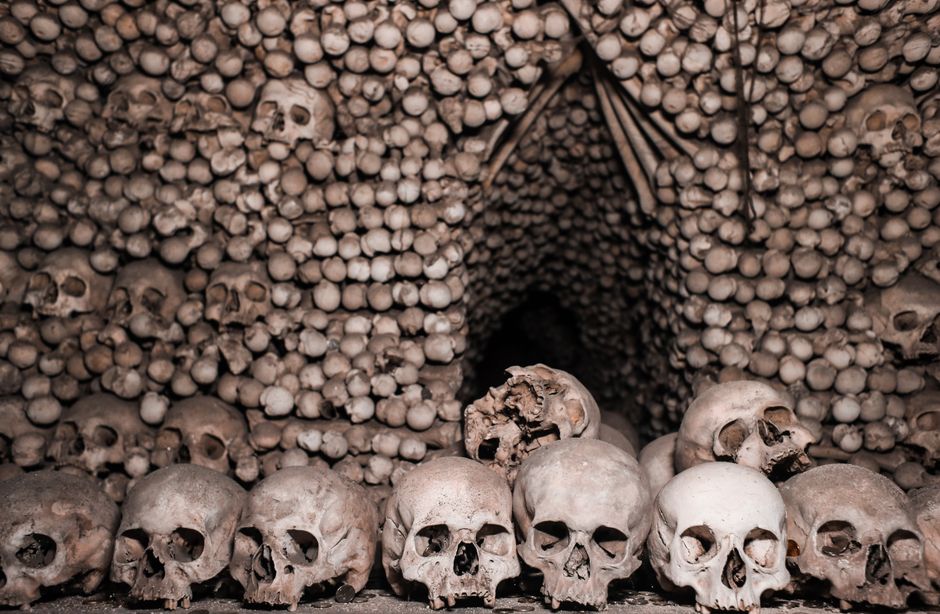
The Paris Catacombs are the largest example of the type. From the late 1780s, the remains of roughly six million people were transferred from the city's overflowing cemeteries into a network of former limestone quarries beneath the streets, where workers stacked the bones into decorative walls. No legend is required to make that unsettling. The catacombs also demonstrate something the ghost stories usually obscure: the real danger below Paris is getting lost in the hundreds of kilometres of unmapped, unlit, unofficial tunnels, which has happened.
The Island of the Dolls in Xochimilco falls somewhere between the two. The dolls are unquestionably there, hung across the island over decades by its caretaker, and the story of the drowned girl that supposedly motivated him is unverifiable. The site is genuinely disturbing regardless of which half you believe.
How We Handle Sources Across Languages
International folklore carries a specific research hazard: most English-language coverage of a legend is a translation of a translation, and details harden with each pass. A creature described as having a particular habit in an English listicle frequently acquired that habit in an earlier English listicle.
Where possible, our profiles state when a legend was first recorded, in what language, and by whom, and separate the earliest attested version from the modern one. Where the earliest source cannot be established, the entry says so rather than smoothing over the gap. The ghoul is a good illustration of why this matters: the Arabic ghul of pre-Islamic and classical tradition is a shape-shifting desert creature that misleads travellers, which is not what the English word came to mean after eighteenth-century translation and later horror fiction reshaped it.
If you want to read more widely in this material, the comparative folklore literature is the most useful starting point — see the reference titles at the end of this guide, or the true horror reading list and the horror movies and gear section for adjacent coverage.
World Ghost Stories & Legends
- 12 Real Haunted Places in the UK: The History Behind Each Legend (2026 Guide)
- Aswang: The True Story Behind the Philippines' Most Feared Creature
- Balete Drive: The True Story Behind the Philippines' Most Famous Ghost
- Bhangarh Fort: The True Story Behind India's Most Haunted Ruin
- Blue Bell Hill: The True Story Behind One of Britain's Most Documented Ghost Legends
- Churel: The True Story Behind South Asia's Vengeful Female Spirit
- Cinco Saltos, Argentina: Inside the Real “City of Witches”
- Edinburgh Castle: The True Story Behind Scotland's Most Haunted Fortress
- Gwisin: The True Story Behind Korea's Restless Spirits
- Island of the Dolls: The True Story Behind Mexico's Most Unsettling Attraction
- Krampus: The True Story Behind Europe's Christmas Demon
- Krasue: The True Story Behind Thailand's Floating Head Ghost
- La Llorona: The True Story Behind Mexico's Weeping Woman
- Lawang Sewu: The True Story Behind Indonesia's Most Haunted Building
- Nasnas: The True Story Behind Yemen's Half-Bodied Monster
- Popobawa: The True Story Behind Zanzibar's Most Feared Spirit
- The Ghoul: The True Story Behind One of Folklore's Most Traveled Monsters
- The Haunted History of Ararat Lunatic Asylum's J Ward
- The Haunted History of Hotel Kurrajong, Canberra
- The Haunted History of Monte Cristo Homestead, Junee
- The Haunted History of the Edifício Joelma, São Paulo
- The Haunted Story of Golf Heights, Banani, Dhaka
- The Haunted Story of Purbo Nayatola Rail Crossing
- The Haunting Story of the BuzzSaw Roller Coaster
- The Paris Catacombs: The True Story Behind the World's Largest Grave
- Tikoloshe: The True Story Behind South Africa's Most Feared Spirit
Where to Start
If you want the best-documented case in this collection, read Blue Bell Hill, where contemporaneous police reports and a real fatal crash sit alongside the apparition accounts.
If you want to see the cross-cultural pattern at work, read La Llorona, Churel, and Krasue in that order. Three continents, one anxiety.
If you want a place rather than a figure, the Paris Catacombs and Lawang Sewu are the two entries where the documented history needs no supernatural help at all.
Two regions were thin in this collection until now: South America and Africa. For the plains and forest spirits, read El Silbón (Venezuela), La Tunda (Colombia), Curupira (Brazil), and El Sombrerón (Guatemala) as a set — four different cultures, the same core idea of a supernatural figure enforcing behavior in the wild. For West Africa, Anansi and the ogbanje are two of the most thoroughly documented belief systems on this site, one a trickster-storyteller figure, the other a cosmology addressing a real and painful pattern of infant mortality. And for a case where the “legend” is really a media myth about a real event, read the Curse of Tutankhamun.
Learn More
- Books on world folklore and international ghost stories
- International mythology and legend reference guides
- Jan Harold Brunvand on urban legends
- Southeast Asian folklore and ghost lore
Frequently Asked Questions
Q1: Why do the same ghost stories appear in different countries?
Two reasons, and they are hard to separate. Some stories travel with people, along trade routes, colonial administrations, and migration, picking up local detail as they go. Others arise independently because they encode an experience or a danger that is not culture-specific — sleep paralysis, drowning, maternal death, being lost at night. Folklorists distinguish migratory legends from independently generated ones, but in most individual cases both processes are at work.
Q2: What is the most haunted place in the world?
The claim is made for dozens of locations and it cannot be settled, because there is nothing measurable to compare. What can be compared is documentation. On that basis the Paris Catacombs, Lawang Sewu, and Edinburgh Castle stand out — not because more is reported there, but because the underlying history is recorded in detail and can be checked.
Q3: Is sleep paralysis the explanation for most ghost encounters?
It accounts for a specific and recognizable subset: encounters that happen in bed, at night, involving inability to move, a sensed presence, and pressure on the chest. That subset is large, and it appears in cultures with no contact with one another, which is why the same experience is named as the Old Hag in Newfoundland, kanashibari in Japan, and Popobawa in Zanzibar. It explains nothing about encounters that happen while the witness is awake and moving.
Q4: Why are so many folklore monsters female spirits who died in childbirth?
Because that death was common, and because the societies where these legends are strongest gave women social standing tied to marriage and childbearing. A story about a returning spirit could carry an accusation — that a family mistreated a daughter-in-law, that a death was avoidable — in a form that could be repeated without naming anyone. La Llorona, Churel, Krasue, and Pontianak are separate traditions doing structurally similar work.
Q5: Can you visit Bhangarh Fort at night?
No. Entry between sunset and sunrise is prohibited and the restriction is posted at the site. The fort itself is a genuine seventeenth-century ruined town and is open during daylight hours. The curse legend attached to it is far less well attested than the fort's documented history.
Q6: Are the Paris Catacombs dangerous?
The official visitor route is safe, ticketed, and short. The wider quarry network beneath the city — hundreds of kilometres of it, largely unmapped and unlit — is a different matter, and unauthorized entry is illegal. People have become lost down there, and the risk has nothing to do with ghosts.
For more death-omen and witch folklore from across Europe, see our pieces on the Irish banshee and Baba Yaga of Slavic folklore.
For more legends with a documented, dated starting point, see our pieces on the real 1953 Albert Bender Men in Black case, the Ouija board’s real 1890 patent history, the real Annabelle doll behind the Warren case, the sleep-science explanation for shadow people, the 1996 origin of the black-eyed kids legend, Virginia’s real Bunny Man police reports, and what’s actually documented about crop circles.
As an Amazon Associate, this site earns from qualifying purchases.

Comments