This article contains affiliate links. If you buy through them, we may earn a commission at no extra cost to you.
St. Nicholas rewards good children. His companion punishes bad ones, and does it with chains, birch switches, and a face built to be genuinely frightening rather than cartoonishly naughty. Krampus has become an international Halloween-adjacent Christmas fixture in recent years, but the popular claim that he’s an ancient pagan god surviving underneath a thin layer of Christianity doesn’t hold up as well as the internet suggests.
- Is Krampus Real?
- What Is Krampus?
- Documented History: What We Can Verify
- The Pagan Origin Theory: What Is Probably Later Folklore
- Krampus and St. Nicholas: How the Pairing Works
- Austria, Germany, and the Alpine Regional Differences
- Krampuskarten: The Postcards That Made Him Famous
- Banned and Revived: Krampus in the 20th Century
- Krampuslauf: The Modern Public Ritual
- Krampus in Pop Culture Today
- Related Alpine Winter Traditions
- Frequently Asked Questions
- Is Krampus really an ancient pagan god?
- When is Krampusnacht?
- What does Krampus actually do to bad children?
- Is Krampus the opposite of Santa Claus?
- Where did Krampus originate?
- Is Krampus a demon?
- What’s the difference between Krampus and the Perchten?
- Why did Krampus become internationally popular?
- Learn More
- Related Stories
Is Krampus Real?
Krampus is real in the sense that matters for folklore: a documented, centuries-old European tradition with parades, costumes, and communities that keep it alive every December. He is not real in the sense of a physical demon — Krampus is a folk figure, not a historical creature, and even his “ancient pagan god” backstory is weaker than most retellings claim. The earliest confirmed written reference to a figure by this name dates to 1580, in a small town in southern Bavaria, several centuries later than the pre-Christian origin story popularly attached to him.
What Is Krampus?
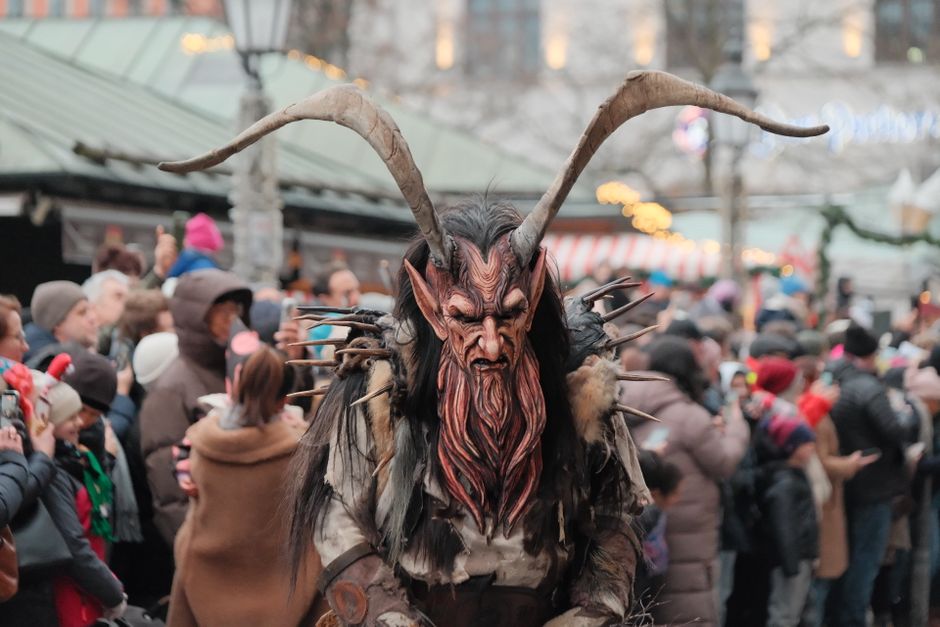
Krampus is typically depicted as a horned, hairy, cloven-hooved figure — part goat, part demon — who accompanies St. Nicholas on his rounds, carrying chains and bundles of birch branches. Where St. Nicholas rewards well-behaved children with gifts, Krampus is said to punish the badly behaved, historically with the threat of a beating and, in the more severe versions of the folklore, by stuffing misbehaving children into a sack and hauling them away entirely. The tradition centers on Krampusnacht — Krampus Night — observed on the evening of December 5th, the night before St. Nicholas Day, when Krampus is said to roam ahead of his companion.
Documented History: What We Can Verify
This is the point where popular retellings and documented history genuinely diverge, and it’s worth being direct about it. Krampus as a named, described figure is not attested in any historical source before the 16th century — the earliest written reference researchers have traced comes from 1580 in southern Bavaria, with the tradition spreading through the wider Alpine region over the following century.
The best-supported account of where he came from is not pagan survival but church theater. American folklorist Al Ridenour, author of The Krampus and the Old, Dark Christmas, traces the likeliest lineage through the late-medieval Nikolausspiele — Church morality plays in which a masked devil figure accompanied St. Nicholas to punish the wicked on stage. Over the early modern period, that stage devil absorbed regional Alpine masking customs and merged with the Perchten, the “rough night” maskers of Salzburg and Tyrol that the folklorist Jacob Grimm cataloged as far back as 1835. Church authorities weren’t always comfortable with the result — the Roman Catholic Church made repeated efforts to ban Krampus traditions, without lasting success, and some accounts tie the custom’s spread partly to Counter-Reformation-era moral theater.
The Pagan Origin Theory: What Is Probably Later Folklore
A common claim holds that Krampus descends from a pre-Christian, pagan Alpine winter-solstice god, absorbed and reframed by Christianity as it spread through the region. It’s a good story, and it shows up in nearly every casual article about him — but historians generally consider it unlikely for a specific, documentable reason: a creature genuinely dating to pre-Christian Alpine paganism would be expected to leave earlier textual or archaeological traces, and those traces simply haven’t been found. The version of the theory that circulates most widely online traces back largely to a single 1958 article by Maurice Bruce in the journal Folklore, which leaned on Margaret Murray’s “witch-cult” thesis — a framework mainstream historians have since classified as pseudohistory. None of this means Krampus has no connection to older Alpine folk belief; the Perchten maskers he merged with likely do reach further back. It means the specific “ancient pagan god survives under Christianity” framing, however widely repeated, outruns what the documented record actually supports.
Krampus and St. Nicholas: How the Pairing Works
Krampus is not a solo villain — the folklore only makes sense as a pair. St. Nicholas represents reward and mercy; Krampus represents consequence. On the evening of December 5th, Krampus is said to go door to door first, rattling chains and threatening misbehaving children, before St. Nicholas follows the next morning to reward the well-behaved with small gifts, fruit, and sweets. It’s a good-cop, bad-cop structure that medieval Church theater used deliberately: fear of Krampus made the reward from St. Nicholas mean more. Strip out the pairing — as most internationally exported versions of Krampus do — and you lose the point of the character, which was never to be frightening for its own sake but to work as one half of a moral lesson.
Austria, Germany, and the Alpine Regional Differences
Krampus belief and Krampusnacht observance are specifically Alpine in origin and remain strongest in Austria, with well-documented variants across southern Germany (particularly Bavaria, where the earliest written record originates), the border regions of Slovenia, northern Italy’s Trentino–Alto Adige/South Tyrol, Hungary, and Romania. This is a genuinely regional tradition rather than a pan-European one — it did not spread the way general Christmas gift-giving customs did, and its persistence in specific mountain regions for roughly five centuries is itself part of what folklorists find notable about it.
Within that Alpine footprint, Krampus is not the only masked winter figure, and he’s often confused with a related but distinct one: the Perchten. Krampus is technically a Schiachperchte — an “ugly” Perchten type, half-human and half-animal, defined by horns, chains, and a long tongue. Other Perchten are unrelated to punishment at all; they represent luck and the turning of the year, and some Perchten runs (particularly in Salzburg) have no St. Nicholas or Krampusnacht connection whatsoever. Costume construction differs too: traditional Krampus masks are hand-carved from Swiss pine, a craft that can carry a real price tag, while many Perchten masks are homemade. Readers researching Alpine winter folklore more broadly may also want to look at Frau Perchta, the Alpine winter goddess whose “rough nights” tradition runs parallel to — and helped shape — the Krampus custom.
Krampuskarten: The Postcards That Made Him Famous
Long before horror movies or social media, Krampus had already gone semi-viral once, through the mail. Austria’s postal system was among the first in Europe to carry illustrated postcards, and by the late 1880s, publishers in Austria and Bavaria were producing Krampuskarten — humorous greeting cards featuring the figure. Typical scenes showed Krampus chasing misbehaving children, tangled comically in his own chains, accompanying St. Nicholas on his rounds, or even flirting playfully in a Belle Époque style of humor that reads as more comic than horrifying by modern standards. The cards were genuinely popular consumer items, not folk-art curiosities, and they’re a large part of why Krampus iconography looks the way it does today — his modern visual identity is arguably more a product of turn-of-the-century printmaking than of medieval church theater.
Banned and Revived: Krampus in the 20th Century
Krampus’s history in the 20th century was not a straight line. During Austria’s Austrofascist period in the 1930s, authorities banned Krampus customs, officially classifying the tradition as degenerate superstition incompatible with the era’s politics. Communities in Alpine towns kept elements of the practice going quietly rather than abandoning it outright, and by the later 20th century, Krampuslauf processions returned publicly and grew rather than faded — the modern surge in Krampus’s international visibility sits on top of a tradition that had already survived one active suppression attempt.
Krampuslauf: The Modern Public Ritual
The tradition’s most visible modern form is the Krampuslauf, or “Krampus run” — a public procession in which participants dress in elaborate, often handmade Krampus costumes and masks and parade through town streets, typically from mid-November through early December, peaking on the evening of December 5th. These processions remain active today across Austria, southern Germany, Italy’s Trentino–Alto Adige/South Tyrol region, Slovenia, Hungary, and Croatia — evidence that Krampus has stayed a living, performed tradition rather than becoming a purely historical curiosity confined to old texts.
Krampus in Pop Culture Today
Krampus has expanded well beyond its original Alpine range in the past two decades, driven substantially by international films, holiday-horror media, and social media coverage of Krampuslauf processions, which has introduced the figure to audiences in North America and elsewhere who have no connection to the original regional tradition. The clearest marker of that crossover is Michael Dougherty’s 2015 film Krampus, a Universal Pictures horror-comedy that grossed roughly $61 million worldwide against a $15 million budget and helped cement the character as an annual American holiday-horror staple. Television had already been building the same crossover for years — Krampus turns up in a 2013 “12 Days of Krampus” episode of NBC’s Grimm, an “American Dad!” holiday episode the same year, and Christmas-themed episodes of shows including Supernatural and Inside No. 9. Folklorists studying the character’s export note a consistent pattern in nearly all of it: the version that spreads internationally tends to emphasize the frightening imagery while dropping the specific St. Nicholas pairing and regional Krampusnacht ritual context that gave the figure its original structure and meaning.
Related Alpine Winter Traditions
Krampus is part of a broader family of European winter folklore built around reward, punishment, and midwinter fear — most of it far less internationally known than Krampus himself has become. Frau Perchta, the Alpine winter goddess whose “rough nights” custom overlaps directly with the Krampus tradition, is the closest relative. Further north, Iceland’s Yule Cat plays a similar role as a midwinter threat aimed at encouraging good behavior, though through a very different folk logic tied to farm labor rather than church theater. And in southern Europe, Italy’s La Befana shows how the same reward-and-punishment structure — gifts for good children, coal or switches for bad ones — recurs across the continent in figures who otherwise look nothing alike.
Frequently Asked Questions
Is Krampus really an ancient pagan god?
Probably not, despite how often the claim gets repeated. Krampus as a named figure isn’t documented before 1580, and the popular “ancient pagan survival” story traces mostly to a single 1958 magazine article built on a discredited framework — documented history simply doesn’t reach as far back as the internet version claims.
When is Krampusnacht?
December 5th, the night before St. Nicholas Day — a fixed, well-documented date in the Alpine tradition, observed with Krampuslauf processions across Austria and neighboring regions.
What does Krampus actually do to bad children?
In the traditional depictions, Krampus swats misbehaving children with birch switches (Ruten) he carries bundled in one hand, and in the more severe versions of the folklore, he’s said to stuff the worst-behaved children into a basket or sack on his back and carry them off. St. Nicholas handles the rewards; Krampus handles the punishment.
Is Krampus the opposite of Santa Claus?
Not quite an opposite so much as a companion figure. In the Alpine tradition, Krampus and St. Nicholas travel together on the same night, December 5th, as a paired good-cop/bad-cop duo — Nicholas rewards well-behaved children the next morning, while Krampus deals with the ones who weren’t.
Where did Krampus originate?
The earliest confirmed written record places him in southern Bavaria in 1580, and the tradition’s strongest, most continuous roots are in Alpine Austria, with well-documented spread into Bavaria (Germany), Slovenia, northern Italy, Hungary, and Romania.
Is Krampus a demon?
He’s designed to look like one — horned, cloven-hooved, carrying chains — but folklorists trace his likeliest origin to a costumed devil character in medieval Church morality plays rather than to any belief in a literal demonic entity. The frightening appearance was a teaching tool, not a claim that the creature was real.
What’s the difference between Krampus and the Perchten?
Krampus is technically classified as a Schiachperchte, or “ugly” type of Perchten — the broader category of Alpine winter maskers. Most other Perchten have nothing to do with punishment; they represent luck and the turning of the year rather than St. Nicholas’s disciplinary companion.
Why did Krampus become internationally popular?
Two separate waves did it: Krampuskarten postcards spread his image across Europe starting in the late 1880s, and a second wave beginning around 2010 — driven by horror films like the 2015 Krampus, social media coverage of Krampuslauf events, and holiday-horror television episodes — introduced him to audiences with no connection to the original Alpine tradition, usually stripped of the St. Nicholas pairing that originally gave the character its point.
Learn More
As an Amazon Associate, this site earns from qualifying purchases.
Comments