This article contains affiliate links. If you buy through them, we may earn a commission at no extra cost to you.
Most “most haunted place” claims are marketing. Bhangarh Fort's is closer to an official government position: a sign posted by India's own Archaeological Survey of India prohibits entry after sunset, and while the stated reason is structural safety, the notice explicitly references supernatural activity — making Bhangarh one of the only nationally protected monuments on Earth with a haunting acknowledged, however obliquely, in its own official signage.
The Site
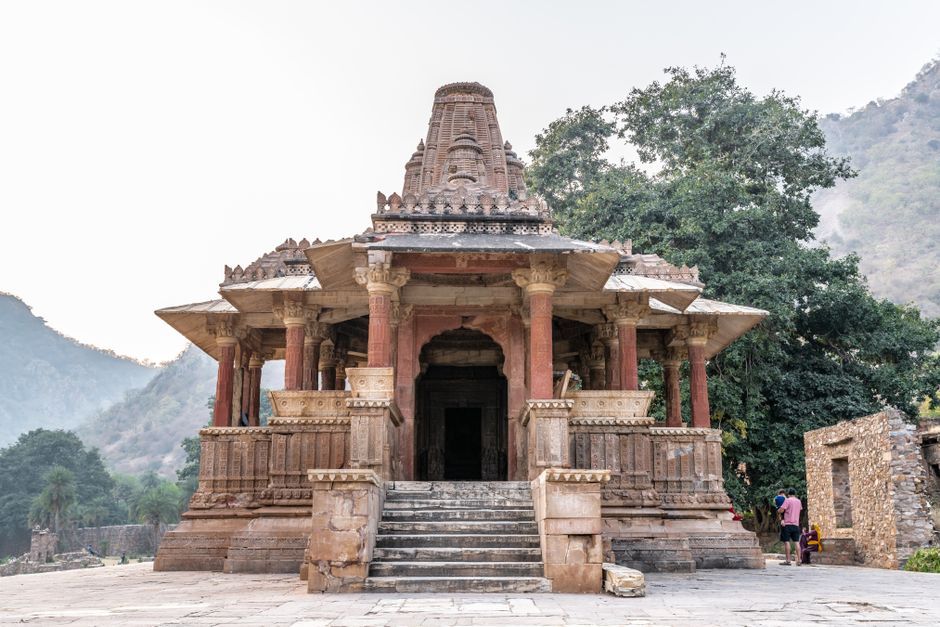
Bhangarh Fort sits at the edge of the Sariska Tiger Reserve in Rajasthan's Alwar district, and it's a real, extensively documented Mughal-era settlement, not a folkloric ruin invented after the fact. It was established in 1573 by Raja Madho Singh I, the younger brother of Man Singh I — one of the Navratnas, the nine celebrated courtiers of Mughal Emperor Akbar. Madho Singh received the territory of Bhangarh as reward for loyal service, and the fort complex, including temples, havelis, and market streets, was built up as a functioning city, not merely a fortress.
The Two Curse Legends
Two distinct legends are passed down to explain the site's abandonment and its reputation:
The Guru Balu Nath legend holds that an ascetic, Guru Balu Nath, had already been meditating on the hillside when Madho Singh chose the site for his city. The guru permitted construction on one condition — that the fort's shadow never fall across his meditation spot — and legend says that when a later ruler's palace extension broke that condition, the guru's curse doomed the city.
The Princess Ratnavati legend describes a renowned beauty, Princess Ratnavati, pursued by a practitioner of black magic named Singhia, who attempted to enchant her using a love potion disguised as perfumed oil. In this version, the princess discovers the trick and destroys the oil, which then kills Singhia — but not before he curses the entire city with his dying breath, dooming it to ruin.
Historical Evidence Versus Folklore
This is where the site's real story and its popular legend clearly diverge. There is no contemporary historical record of a Princess Ratnavati or the specific tantrik plot involving Singhia — the tale appears to have emerged later, likely in the 19th or early 20th century, as a folk explanation constructed around the site's already-dramatic ruins, rather than as a record of an actual event.
The historically supported explanation for Bhangarh's abandonment is considerably less supernatural: a combination of Mughal political disruption, famine, and broader economic decline across the region in the late 17th century. Both curse narratives — the tantrik Singhia and the ascetic Guru Balu Nath — function as local legend layered onto a genuine, documented historical decline, not as competing factual accounts of it.
The Official Haunting
What makes Bhangarh unusual isn't the curse stories themselves — plenty of ruins have similar tales — but the Archaeological Survey of India's formal response to them. The ASI's posted notice prohibits visitors and staff from entering the fort complex between sunset and sunrise, officially citing the dilapidated condition of the structures and lack of lighting as public safety concerns. Numerous visitor and local accounts note that the sign also explicitly references restrictions tied to supernatural activity, a detail that has made Bhangarh one of the very few government-protected heritage sites with any official acknowledgment, however cautious, of a paranormal reputation.
Can You Visit?
Bhangarh Fort is open to the public during daylight hours and draws more than 200,000 visitors annually, most coming for its genuine historical and architectural significance as a well-preserved Mughal-era settlement rather than purely for the ghost stories. Night entry is not permitted under any circumstance, regardless of a visitor's skepticism about the curse — the ASI's restriction is enforced as an active site rule, not a suggestion.
Frequently Asked Questions
Does the Indian government really acknowledge Bhangarh Fort is haunted?
A sign from the Archaeological Survey of India prohibits entry after sunset and explicitly references supernatural activity alongside the stated structural-safety reason — an unusual case of official signage touching on a haunting claim, even if obliquely.
Is Bhangarh Fort a real historical site?
Yes — it’s an extensively documented Mughal-era settlement established in 1573, not a folkloric ruin invented after the fact.
Ghost-Hunting Gear & Further Reading
As an Amazon Associate, this site earns from qualifying purchases.
Pin this for later


Comments