This article contains affiliate links. If you buy through them, we may earn a commission at no extra cost to you.
Southeast Asia has produced few images as immediately disturbing as this one: a woman's head, detached from her body entirely, floating through the night with her internal organs still trailing beneath her neck. In Thailand she's Krasue. Cross a border and she has a different name, a different regional flavor, but almost the same silhouette — a pattern that tells its own story about how folklore travels.
- What Is Krasue?
- Appearance and Behavior
- The Thai Folk Explanation: Sin, Not Random Chance
- Where the Legend Actually Comes From
- Not Unique to Thailand: A Regional Cluster
- Documented Belief vs. Oral Tradition — What's Actually Verifiable
- From Comic Panel to Movie Screen: Krasue in Pop Culture
- Cultural Significance Today
- Frequently Asked Questions
- Is Krasue unique to Thailand?
- What is a Krasue believed to have been before transformation?
- What does a Krasue hunt for at night?
- How is Krasue different from the Philippines' Manananggal or Malaysia's Penanggalan?
- Is the Krasue legend documented history or oral tradition?
- Where does the Krasue image come from in modern pop culture?
- How old is the Krasue legend?
- Do people still believe in Krasue today?
- Learn More
- Related Stories
What Is Krasue?
Krasue (�e01;�e23;�e30;�e2a;�e37;�e2d, sometimes romanized Krahang or Kra-sue) is one of the most widely recognized spirits in Thai folklore: a woman's severed head that detaches from her body after dark and floats through the night with her esophagus, lungs, stomach, and intestines still attached, dangling below the neck. By day, tradition says, she looks and lives like an ordinary woman, with no visible sign of what she becomes once the sun goes down. That daylight-normal, nighttime-monstrous split is part of what makes the legend unsettling — the threat isn't a stranger from outside the village, it could be someone you already know.
Appearance and Behavior
Descriptions of Krasue are fairly consistent across regional retellings. She's usually depicted as young and conventionally attractive, her severed head trailing a visible rope of organs that glow faintly as she drifts — several accounts compare the glow to a will-o'-the-wisp, the same natural phenomenon (marsh gas igniting over wetlands) that shows up in ghost-light legends worldwide. She hunts after dark for blood, raw or spoiled meat, and carrion, and in the more feared versions of the story she's drawn specifically to the placenta and blood associated with childbirth.
That last detail isn't a minor flourish. Southeast Asian folklore has a recurring, cross-cultural pattern of spirits that specifically target pregnant women and newborns, and Krasue sits squarely inside it. Folk explanations for this vary by teller: some trace it to fear of the very real dangers of childbirth in eras before modern maternal care, when a difficult birth or a mother's death got explained through supernatural cause rather than medical accident. That reading is a folkloric interpretation rather than a claim documented in any single historical source, but it fits how these legends functioned — giving a shape and a reason to a fear that communities didn't otherwise have language for.
The Thai Folk Explanation: Sin, Not Random Chance
Thai tradition holds that a Krasue is the transformed spirit of a woman who committed serious sins or engaged in fraudulent, dishonest conduct during her lifetime. After death, this legend says, her karma manifests physically: she's reborn or transformed into a phi — a spirit — forced to sustain herself on rotten, uncooked, or otherwise unwanted food. That's a meaningful structural choice worth sitting with: the story ties the creature's monstrous hunger directly to a specific moral failing in life, rather than treating her as a random supernatural predator who simply exists. Some retellings go further and describe more specific origin stories — a midwife whose skill with anatomy and herbs drew envy and suspicion, or a woman cursed by a scorned lover — though these versions vary by region and storyteller rather than forming one settled canon.
Where the Legend Actually Comes From
Krasue belief is difficult to trace to one clean point of origin, and we want to be direct about that rather than manufacture false precision. Some accounts place the legend's roots as far back as the historical Khmer Empire, and while Krasue stories circulated primarily through oral tradition, documented evidence of the belief's age does exist in physical form: temple murals and village records in central Thailand, along with 19th-century ethnographic reports, depict female figures with floating heads consistent with the Krasue image, confirming the belief was established in rural imagination well before any modern retelling. Beyond that, the trail goes cold in the way most oral folklore does — no single origin text, no named first storyteller, just a belief that was clearly already old by the time anyone started writing it down.
Not Unique to Thailand: A Regional Cluster
What makes Krasue worth separating from a purely local ghost story is how consistently the same core image — a woman's floating head trailing its own organs — reappears across Southeast Asia under different regional names. Malaysia has the Penanggalan-adjacent traditions and the Philippines has its own self-segmenting relative in the Manananggal, described as splitting at the torso rather than the neck but sharing the same nocturnal, organ-trailing, blood-hunting profile. Cambodia has the Ahp, described in almost identical terms to Krasue — a floating woman's head with visceral organs attached, hunting at night for similar prey. Laos has a close cousin also called Krasu or Kasu. Borneo folklore includes the Kuyang, and Bali has the Leyak, which shares the flying-head motif within a broader shapeshifting tradition. Folklorists studying this cluster generally treat it as evidence of a shared or cross-pollinated regional folk tradition — some point to possible Austronesian linguistic roots connecting several of these names — rather than several unrelated cultures independently inventing the same specific, unusual image, though the exact direction of transmission between these traditions remains debated rather than settled.
Krasue vs. Ahp vs. Penanggalan: What Actually Differs
Side by side, the differences are more about regional texture than substance. Krasue (Thailand) and Ahp (Cambodia) are close enough that some researchers treat them as regional variants of the same belief rather than separate creatures — both are explained through a woman's past-life sin or transgression, both hunt blood and carrion, both are feared most around childbirth. Penanggalan, more associated with Malay tradition, is typically described as detaching cleanly at the neck the way Krasue does, versus the Manananggal of the Philippines, which is usually described splitting at the torso and growing bat-like wings to fly — a physically distinct method of separation even though the hunting behavior and vulnerability to certain protective measures (natural thorns, garlic, sharp objects placed at the neck-stump in some tellings) echo across all of these traditions. The consistent thread connecting all of them is the same core fear: a woman's body made monstrous and airborne, hunting exactly when a household is most vulnerable.
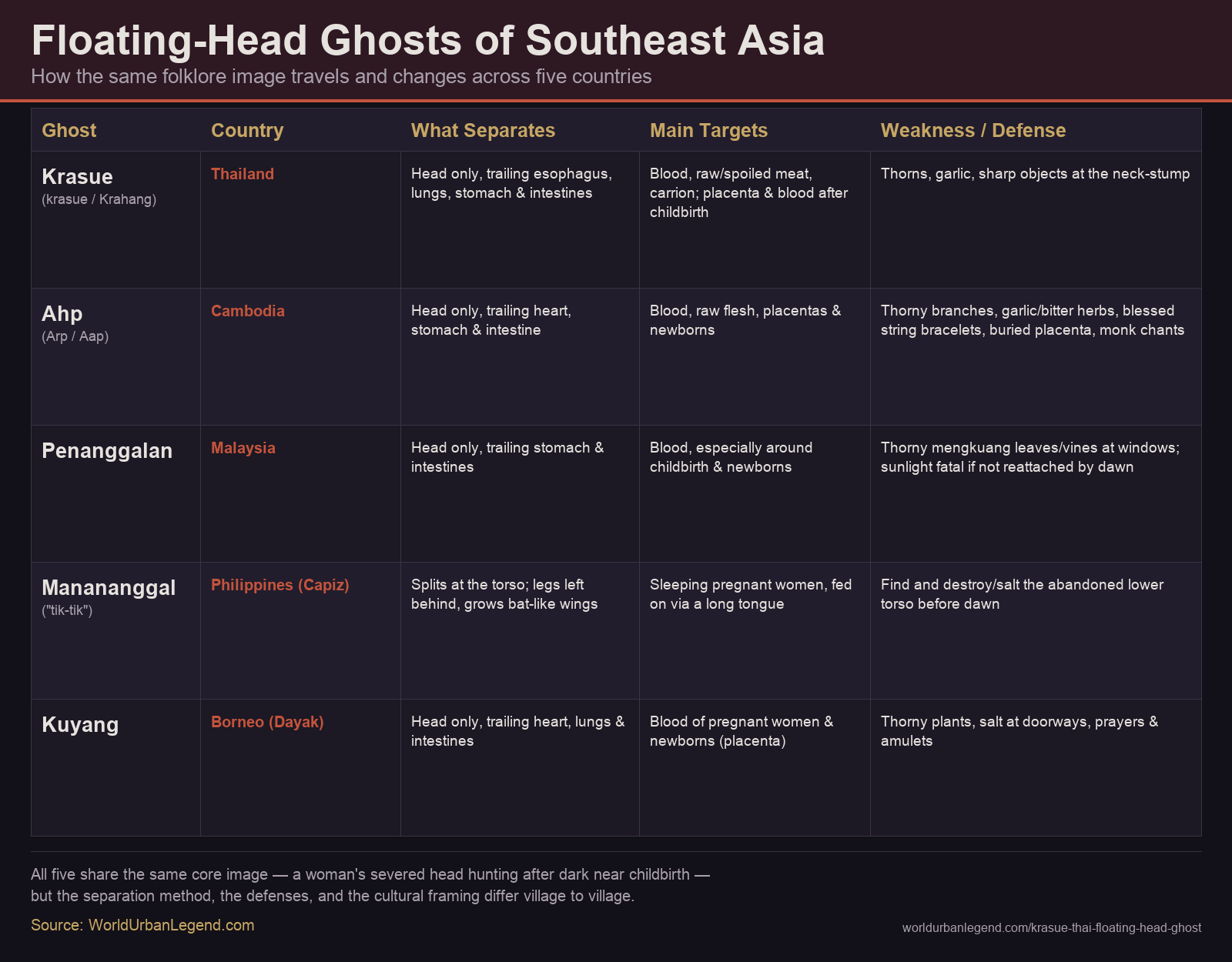
This comparison chart may be republished freely with attribution and a link to this page.
Embed this chart:
<img src="https://worldurbanlegend.com/wp-content/uploads/2026/08/floating-head-ghosts-southeast-asia-comparison.png" width="1600" height="1250" alt="Comparison chart of Southeast Asian floating-head ghosts: Krasue, Ahp, Penanggalan, Manananggal, and Kuyang" loading="lazy" style="max-width:100%;height:auto" />
<p>Source: <a href="https://worldurbanlegend.com/krasue-thai-floating-head-ghost/">https://worldurbanlegend.com/krasue-thai-floating-head-ghost/</a></p>
Documented Belief vs. Oral Tradition — What's Actually Verifiable
It's worth being precise about what "documented" means here, because Krasue sits at an interesting line between the two. The core belief — a floating woman's head with trailing organs, feared at night — is attested in physical, dateable sources: temple murals, village records, and 19th-century ethnographic accounts from central Thailand. That establishes the belief existed and roughly how old it is. What isn't documented in the same way is any single, agreed-upon origin story, a first-recorded telling, or a clean explanation of exactly how the belief spread between Thailand, Cambodia, Laos, and beyond. That part remains oral tradition — passed storyteller to storyteller, varying by village and generation, with scholars inferring cross-pollination from the pattern of similarity rather than from a paper trail. Readers researching Krasue should treat the "is it real" question as two separate questions: is the belief real and long-standing (yes, well-documented) and is there one true, verifiable origin story (no, and no serious source claims otherwise).
From Comic Panel to Movie Screen: Krasue in Pop Culture
The image most people now associate with Krasue owes as much to 20th-century media as it does to oral tradition. A 1968 comic book, Krasue Sao, is widely credited with fixing the now-familiar visual of the creature in Thai popular imagination, and its 1973 film adaptation — released internationally as Ghost of Guts Eater — became the first Thai horror film built specifically around the legend. That film and its 1985 follow-up, Krasue Krahai Lueat, set a template that Thai cinema has returned to for decades since, treating Krasue less as a one-off monster and more as a recognizable genre fixture, comparable to how vampires function as a standing genre in Western horror. It's worth separating this cinematic lineage from the folk belief itself: the comic and films popularized and to some extent standardized her appearance, but they didn't invent the underlying tradition, which predates them by generations.
Cultural Significance Today
Krasue remains one of the most consistently adapted figures in Thai horror cinema, and her cross-border cousins across Malaysia, Cambodia, Laos, the Philippines, and Borneo suggest that whatever the belief's ultimate origin, it tapped into something regionally shared — a fear specific enough in its imagery, and widespread enough in its distribution, that Southeast Asian folklore scholars treat the entire cluster as one connected tradition worth studying together rather than as isolated national legends. The belief also persists outside of cinema: in parts of rural Thailand, Krasue is still referenced as a living folk belief rather than purely a movie monster, particularly around precautions historically taken by households after a birth — a distinction worth holding onto, since a legend that's still spoken of as potentially real functions differently in a community than one that has fully migrated into pure entertainment.
Related: Kuman Thong: The Story Behind Thailand’s Child-Spirit Amulet, More Southeast Asian ghosts and folklore.
Related: Naga Fireballs: The True Story of the Mekong River Lights.
Frequently Asked Questions
Is Krasue unique to Thailand?
No — the same floating-head, trailing-organs image appears across Southeast Asia under different regional names, including the Ahp in Cambodia, Krasu in Laos, Penanggalan in Malaysia, the Manananggal in the Philippines, and Kuyang in Borneo folklore. It's a pattern that illustrates how this folklore image traveled and adapted across borders rather than a single national legend.
What is a Krasue believed to have been before transformation?
Thai tradition holds she was a woman who committed serious sins or dishonest conduct during life, with her karma manifesting physically after death as a floating, organ-trailing spirit forced to feed on rotten or uncooked food. Some regional retellings add more specific backstories, such as a midwife or a woman cursed by a scorned lover, though these vary by teller.
What does a Krasue hunt for at night?
Blood, raw or spoiled meat, and — in some of the more feared versions of the legend — the placenta or blood of women who have recently given birth. That detail ties Krasue folklore into a broader regional pattern of ghosts specifically feared around childbirth, which historically shaped precautions some rural households took after a birth.
How is Krasue different from the Philippines' Manananggal or Malaysia's Penanggalan?
The core image is nearly identical — a woman's head with trailing organs, hunting at night — but the mechanics differ. Krasue and Penanggalan are usually described detaching cleanly at the neck, while the Manananggal is typically described splitting at the torso and growing wings to fly. The Cambodian Ahp is close enough to Krasue that some researchers treat the two as regional variants of the same underlying belief.
Is the Krasue legend documented history or oral tradition?
Both, depending on which part of the question you're asking. That the belief existed and is old is documented: temple murals, village records, and 19th-century ethnographic reports from central Thailand depict figures consistent with Krasue. But the specific origin story, and exactly how the belief spread between countries, remains oral tradition without a clean documented paper trail.
Where does the Krasue image come from in modern pop culture?
Much of today's visual shorthand for Krasue traces to a 1968 comic book, Krasue Sao, and its 1973 film adaptation known internationally as Ghost of Guts Eater — the first Thai horror film built around the legend. That cinematic lineage popularized her modern look but didn't create the underlying folk belief, which predates the comic by generations.
How old is the Krasue legend?
Hard to date to one clean point of origin, but some accounts trace its roots as far back as the Khmer Empire. Documented evidence of the belief's age exists in physical form: temple murals and village records in central Thailand, along with 19th-century ethnographic reports, depict female figures with floating heads consistent with the Krasue image.
Do people still believe in Krasue today?
In parts of rural Thailand, yes — Krasue is still referenced as a living folk belief rather than purely a horror-movie monster, particularly in relation to older precautions taken around childbirth. In urban areas and internationally, she's much more commonly encountered through film and pop culture than as an active belief.
Learn More
- Books on Southeast Asian folklore and ghost traditions
- Thai horror cinema and cultural history guides
As an Amazon Associate, this site earns from qualifying purchases.