This article contains affiliate links. If you buy through them, we may earn a commission at no extra cost to you.
In 1991 a New York appellate court ruled that a house in Nyack was, as a matter of law, haunted. The buyer wanted his deposit back after discovering that the seller had spent years publicizing the property's ghosts in Reader's Digest and on local walking tours. The court did not find that ghosts exist. It found that the seller had created the reputation, had profited from it, and could not then deny it to a buyer who had no way of knowing. He got his deposit back.
Stambovsky v. Ackley is the cleanest illustration of how American hauntings actually work. The question is rarely whether something is there. The question is what a reputation does — to a building, to a town, and to the record of what happened in it.
This guide indexes every U.S. haunted location and legend this site has covered, along with a handful of entries from elsewhere in the Americas that sit naturally alongside them. Each is treated with the same standard: documented history first, hedged as legend where the record cannot confirm the specifics.
Looking for folklore beyond the U.S.? See our International Ghost Stories & Haunted Places guide, or our Japanese Yokai & Urban Legends collection.
Haunted Places by State
Every state below has its own guide that separates what the record shows from what the ghost tours claim.
United States
- Alabama
- Alaska
- Arizona
- Arkansas
- California
- Colorado
- Connecticut
- The Dakotas
- Delaware
- Florida
- Georgia
- Hawaii
- Illinois
- Indiana
- Iowa
- Kansas & Nebraska
- Kentucky
- Louisiana
- Maine
- Maryland
- Massachusetts
- Michigan
- Minnesota
- Mississippi
- Missouri
- Montana, Idaho & Wyoming
- Nevada
- New Hampshire
- New Jersey
- New Mexico
- New York
- North Carolina
- Ohio
- Oklahoma
- Oregon
- Pennsylvania
- Rhode Island
- South Carolina
- Tennessee
- Texas
- Utah
- Vermont
- Virginia
- Washington
- West Virginia
- Wisconsin
International
The Four Buildings America Haunts
Walk through any state list on this site and the same four building types keep appearing. That is not a coincidence, and it is not evidence of anything supernatural. It is architectural and institutional history showing through.
Asylums
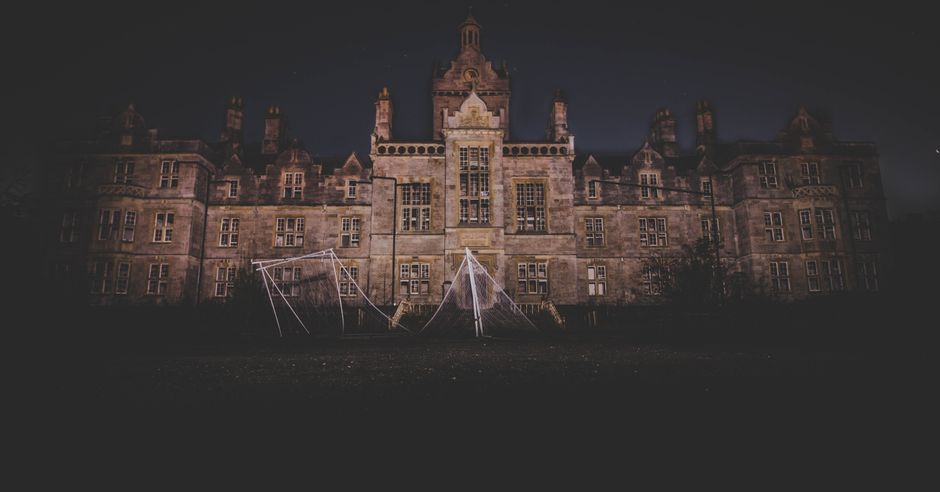
Between the 1840s and the end of the century, dozens of American states built enormous psychiatric hospitals to a template devised by the physician Thomas Story Kirkbride: a central administrative block with long staggered wings reaching back on either side, set in landscaped grounds, designed so every ward received sunlight and air. The theory was that architecture itself could be therapeutic.
What the theory did not survive was overcrowding. Institutions built for a few hundred patients held thousands by the mid-twentieth century, and the treatment record from that period is genuinely grim without any supernatural addition. When deinstitutionalization emptied the buildings from the 1960s onward, what remained were vast, decaying, architecturally imposing structures with documented histories of suffering and no economic use. Every element of a haunting was already in place. Our list of horror movies set in real asylums and hospitals covers how film has used the same buildings.
Tuberculosis Sanatoriums
Before antibiotics, tuberculosis treatment meant isolation, rest, and fresh air, which meant purpose-built hospitals sited away from towns, with open-air porches and their own mortuary infrastructure. Death rates were high because the disease was, at the time, largely untreatable. Streptomycin changed that in the late 1940s, and within two decades the sanatorium system was obsolete.
The buildings that survive tend to be the largest ones, and their reputations rest on a real body count that is a matter of public health record rather than legend.
Prisons
Eastern State Penitentiary in Philadelphia opened in 1829 as the flagship of the Pennsylvania system, which held that solitary confinement and enforced silence would produce genuine penitence. Prisoners were hooded when moved so they could not see or be seen. Charles Dickens visited in 1842 and wrote that the regime inflicted a torture on the mind worse than any physical punishment.
Prison hauntings almost always trace back to this design philosophy rather than to executions. The buildings were engineered for isolation, and the acoustics of a stone cellblock do the rest.
Hotels
Hotel hauntings are the most commercially entangled category, because a hotel is the only one of the four that profits directly from the story. The Stanley Hotel in Estes Park, Colorado is the clearest case: Stephen King and his wife stayed there in 1974 near the end of the season, in a nearly empty building, and the stay fed directly into The Shining. The hotel now runs ghost tours. The literary history is fully documented; the hauntings are reputation.
This is worth keeping in mind whenever a haunted location sells tickets. A commercial interest in the story does not make the story false, but it does mean nobody involved has any incentive to investigate it.
The Evidence Problem: When the Record Starts Late
The most useful question to ask about any American haunting is not “what happened“ but “when was this first written down, and by whom.“
The Bell Witch is the standard case. The events are said to have afflicted the Bell family of Adams, Tennessee between roughly 1817 and 1821. The full narrative that everybody now repeats — the voice, the beatings, the death of John Bell — comes from Martin Van Buren Ingram's book, published in 1894. That is more than seventy years after the fact, drawing on a manuscript whose provenance cannot be independently verified. The Bell family existed and the local tradition is genuinely old, but the story as told is a late-Victorian document, and it reads like one.
The same pattern repeats across the country. Louisiana's Myrtles Plantation is famous for the story of an enslaved woman named Chloe who poisoned a birthday cake; historians working from the property's own records have found no evidence that she existed, and the story appears to postdate the house's conversion into a tourist attraction. Plenty of genuinely documented deaths occurred there. The famous one did not.
Where the record starts early, it is a different matter entirely. The Salem witch trials of 1692 produced court documents, depositions, and execution records that survive in quantity: nineteen people were hanged, Giles Corey was pressed to death for refusing to plead, and several more died in jail. Almost nothing about that needs hedging, which is why it remains the most-studied episode in American folk history — our guide to books about the Salem witch trials works through the literature.
The useful distinction: a legend with an early paper trail can be checked. A legend whose first written appearance is a tourism-era book cannot be checked, and usually was not meant to be.
Regional Character
American hauntings are not distributed evenly, and they are not the same kind of story from region to region.
New England hauntings run on documents. The colonial record is deep, the towns are old, the graveyards are intact, and the stories tend to be about specific named people whose court appearances and burials can be located. Massachusetts alone accounts for one of the longest lists on this site.
The South produces the most narratively developed hauntings, frequently attached to plantation houses, and this is where the evidence problem is most acute. The story that gets told is often the one the house needed in order to attract visitors, and it frequently sits on top of a much uglier documented history that the ghost story displaces rather than preserves.
The West haunts its infrastructure. Mining towns, hotels built for railway passengers, and roads through empty country produce hauntings tied to sudden violent death and to isolation rather than to family drama. Bragg Road in Texas, with its long-reported ghost light, is a good example of a legend attached to a road rather than a building.
The borderlands carry stories that predate the border. La Llorona and the Chupacabra circulate on both sides of it, and neither can usefully be filed as an American legend.
And some legends have no location at all. Bloody Mary lives in any bathroom mirror, which is precisely why the ritual has survived: it needs nothing but a dark room and a group of children willing to dare each other.
Before You Visit
Most of the abandoned buildings on these lists are private property, and a significant number of them are structurally dangerous. Asbestos, lead paint, collapsed flooring, and open shafts are the realistic hazards in a derelict asylum or sanatorium, and trespassing charges are the realistic legal outcome.
Locations that run official tours are the practical option, and they are usually better documented than anything you would find on your own. If you do intend to investigate, our beginner ghost hunting equipment guide covers what the gear does and does not tell you, and the wider gear and media section covers recorders, cameras, and reading.
U.S. Haunted Places & Legends
- 10 Real Haunted Places in Alaska: The History Behind Each Legend (2026 Guide)
- 14 Real Haunted Places in California: The History Behind Each Legend (2026 Guide)
- 15 Real Haunted Places You Won't Find in Guidebooks
- 15 Real Haunted Places in Texas: The History Behind Each Legend (2026 Guide)
- 18 Real Haunted Places in Arizona: The History Behind Each Legend (2026 Guide)
- 18 Real Haunted Places in Massachusetts: The History Behind Each Legend (2026 Guide)
- 18 Real Haunted Places in New Jersey: The History Behind Each Legend (2026 Guide)
- 19 Real Haunted Places in Washington State: The History Behind Each Legend (2026 Guide)
- 20 Real Haunted Places in North Carolina: The History Behind Each Legend (2026 Guide)
- 20 Real Haunted Places in Pennsylvania: The History Behind Each Legend (2026 Guide)
- 20 of the Most Haunted Places in Colorado
- 25 Real Haunted Places in Michigan: The History Behind Each Legend (2026 Guide)
- 28 Real Haunted Places in Florida: The History Behind Each Legend (2026 Guide)
- 30 Real Haunted Places in Ohio: The History Behind Each Legend (2026 Guide)
- Bloody Mary: The True Story Behind the Mirror Legend
- Boyington Oak: The Tree That Grew From a Hanged Man's Grave
- Bragg Road, Texas: The Real History Behind the “Ghost Road”
- Chupacabra: The True Story Behind Latin America's Most Famous Cryptid
- The Bell Witch: The True Story Behind Tennessee's Most Famous Haunting
- The Haunted History of Coiba Island Prison
- The Haunted History of Deane House
- The Haunted History of the Banff Springs Hotel
- The Haunted History of the Fairmont Hotel Macdonald
- The Haunted History of the Firkins House, Edmonton
- The Haunted Story of the Dr. John R. Drish House in Tuscaloosa, AL
Where to Start
If you want the single best-documented American haunting, read the Bell Witch first, then notice how much of what you already believed about it comes from one 1894 book.
If you want places you can actually visit, start with the state guides for Massachusetts or Pennsylvania, both of which are heavy on sites with official access.
If you want the folklore rather than the buildings, Bloody Mary and La Llorona are the two American legends with the widest reach and the deepest history.
Ghost-Hunting Gear & Further Reading
- Best ghost hunting equipment for beginners
- Books on American haunted places and folklore
- Histories of the Salem witch trials
- Abandoned America photography books
Frequently Asked Questions
Q1: What is the most haunted place in the United States?
There is no answer to this that is anything other than a popularity contest, because there is no measurable quantity to rank. The locations that top most lists — Eastern State Penitentiary, the Winchester Mystery House, the Stanley Hotel, Waverly Hills — share two traits: a genuinely documented and often unhappy institutional history, and an active commercial operation that keeps the story in circulation. Both matter, and only one of them is evidence.
Q2: Do sellers have to disclose that a house is haunted?
It depends on the state, and the leading case is Stambovsky v. Ackley (New York, 1991), in which a court allowed a buyer to rescind a purchase because the seller had publicly established the house's haunted reputation and then failed to disclose it. The ruling turned on the reputation as a material fact affecting value, not on the existence of ghosts. Several states have since addressed “stigmatized property“ in statute, and the requirements vary considerably.
Q3: Why are so many haunted places old asylums?
Because America built a great many of them to an imposing standard, filled them far beyond capacity, and then abandoned them almost simultaneously when psychiatric care moved into the community from the 1960s. The result was hundreds of enormous, architecturally dramatic, structurally decaying buildings with a documented history of institutional suffering and no remaining purpose. The ghost stories arrived after the abandonment, not before.
Q4: Is the Bell Witch story true?
The Bell family of Adams, Tennessee is real and the local tradition is old. The detailed narrative, however, comes from a book published in 1894 — more than seventy years after the events it describes — based on a source that cannot be independently verified. Treat the family and the tradition as historical, and the specifics as a Victorian construction.
Q5: Is it legal to visit abandoned haunted places?
Usually not. Most abandoned buildings in the United States have an owner, and entering without permission is trespassing regardless of how derelict the structure looks. Beyond the legal question, derelict institutional buildings carry real hazards — asbestos, lead, unstable flooring, uncapped shafts. Locations that run official tours are both the lawful option and, in most cases, the better documented one.
Q6: Why do ghost stories cluster around bridges and roads?
Because those are the places where sudden death happened in front of witnesses, and because they are transitional spaces — you are not anywhere while you are on them. Ghost light legends attached to long straight rural roads, of which Bragg Road in Texas is a well-known example, tend to have candidate physical explanations involving distant headlights and atmospheric refraction, which does not appear to have reduced their appeal at all.
Beyond haunted buildings and roads, the U.S. has its share of cryptid-style legends tied to real events — see our deep dive on the 1966-67 Mothman sightings in Point Pleasant, West Virginia.
The U.S. also has well-documented folklore tied to real cultural traditions and historic properties — see our pieces on Skinwalker folklore and Skinwalker Ranch and the Wendigo of Algonquian legend.
As an Amazon Associate, this site earns from qualifying purchases.
More U.S. legends and landmarks
- Is the Bell Witch Real? What the Historical Record Shows
- Michigan Dogman: The 1987 Radio Prank That Became a Legend
- Centralia, Pennsylvania: The Town That’s Been Burning Since 1962
- The Jersey Devil: The Real History Behind the Pine Barrens Legend
- The Beast of Bray Road: Wisconsin’s Modern Werewolf Sightings
Comments