This article contains affiliate links. If you buy through them, we may earn a commission at no extra cost to you.
Florida's haunted reputation runs from a 12th-century Spanish monastery shipped stone-by-stone across the Atlantic to a spiritualist town where mediums have practiced since 1894. Below are 28 real locations, each with the documented history first and the ghost story second, presented as local legend rather than fact.
Quick answer if you're short on time: St. Augustine Lighthouse, the Biltmore Hotel (Coral Gables), and the Old Jail museum in St. Augustine are the most historically documented and most tourable sites on this list.
- 1. St. Augustine Lighthouse (St. Augustine)
- 2. Casa Monica Resort & Spa (St. Augustine)
- 3. The Old Jail (St. Augustine)
- 4. The Don CeSar Hotel (St. Pete Beach)
- 5. The Vinoy Renaissance St. Petersburg Resort & Golf Club (St. Petersburg)
- 6. The Biltmore Hotel (Coral Gables)
- 7. The Riddle House (West Palm Beach)
- 8. The Ancient Spanish Monastery (North Miami Beach)
- 9. The St. Petersburg Shuffleboard Club (St. Petersburg)
- 10. The Tampa Theatre (Tampa)
- 11. Crystal River Archaeological State Park (Crystal River)
- 12. The Cuban Club / Círculo Cubano (Ybor City, Tampa)
- 13. Stranahan House (Fort Lauderdale)
- 14. Belleview Biltmore Hotel site (Belleair, near Clearwater)
- 15. Blowing Rocks Preserve (Jupiter Island)
- 16. The Old Carrabelle Hotel (Carrabelle)
- 17. The Devil's Chair (Cassadaga)
- 18. The Ritz Theater / Wayne Densch Performing Arts Center (Sanford)
- 19. The Calaboose, Punta Gorda History Park (Punta Gorda)
- 20. Ormond Beach Hotel site (Ormond Beach)
- 21. L'Unione Italiana / Italian Club (Ybor City, Tampa)
- 22. Bok Tower Gardens (Lake Wales)
- 23. Florida Theatre (Jacksonville)
- 24. Old Baker County Jail (Macclenny)
- 25. Cassadaga Hotel (Cassadaga)
- 26. Evergreen Cemetery (Jacksonville)
- 27. May-Stringer House (Hernando Heritage Museum, Brooksville)
- 28. State Theatre / Floridian Social Club (St. Petersburg)
- Sources
1. St. Augustine Lighthouse (St. Augustine)
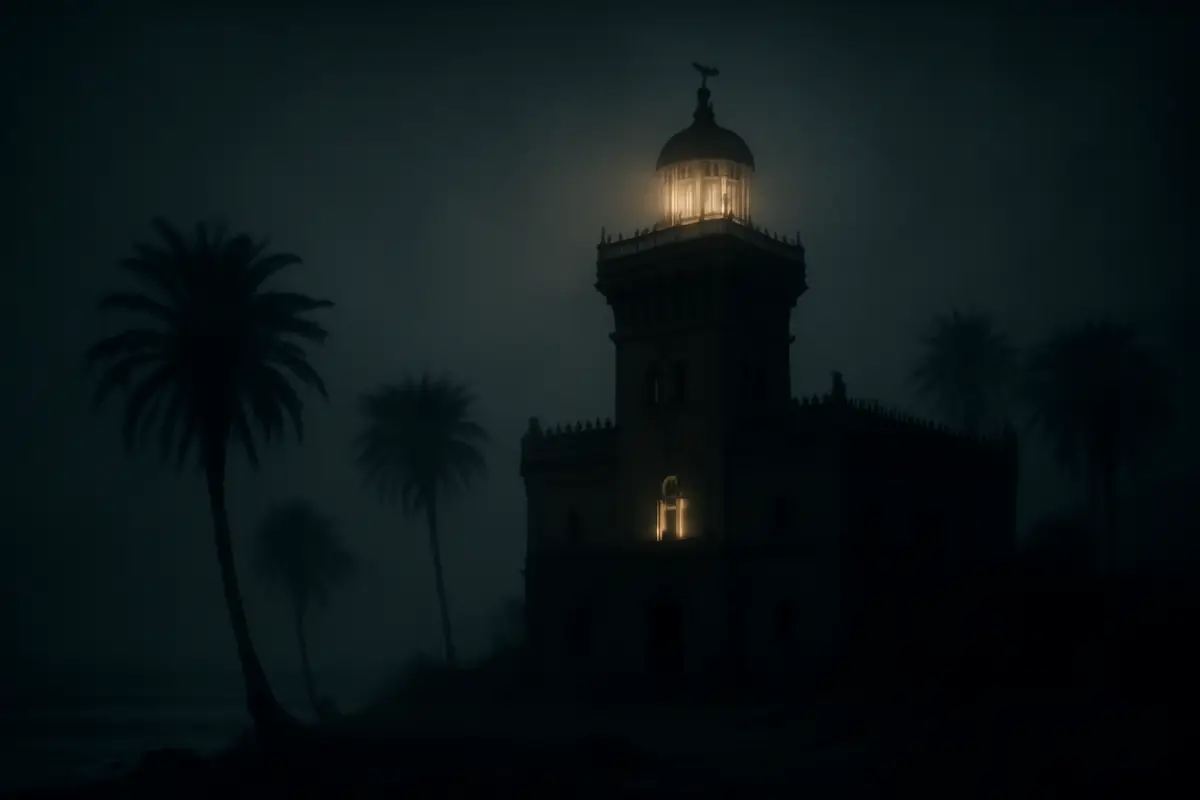
The current lighthouse, standing 165 feet on Anastasia Island, has guided ships since 1874, with a keeper's house added in 1876. Its history includes real deaths. Joseph Andreu, keeper of the earlier Spanish-era tower, fell from scaffolding while whitewashing it in 1859. On July 10, 1873, during construction of the new tower, a supply cart carrying children of construction superintendent Hezekiah Pittee ran into the water, and two of his daughters, and by some accounts a third girl, drowned. Head Keeper William Harn died of tuberculosis in 1889. In 1970 the vacant keeper's house was gutted by a fire of undetermined origin; a 15-year, $1.2 million restoration followed.
Visitors and staff describe children's laughter and running footsteps on the spiral stairs, especially near dusk, and many attribute them to the Pittee girls. The drowning is documented; the haunting is legend.
Can you visit: Yes — the lighthouse and keeper's house operate as a museum with tower climbs and ghost tours available.
2. Casa Monica Resort & Spa (St. Augustine)
Built in 1888 by architect Franklin W. Smith, the hotel struggled financially within months and was sold to Henry Flagler for $325,000. Flagler renamed it the Cordova Hotel; it later served for decades as the St. Johns County courthouse. Developer Richard Kessler bought and restored it and reopened it as Casa Monica in December 1999, largely preserving Smith's original Moorish Revival design.
Hotel lore says a woman in a flowing white gown wanders the fourth-floor hallways — a legend with no confirmed identity behind it.
Can you visit: Yes — it operates as a full-service hotel open to the public.
3. The Old Jail (St. Augustine)
Financed by Henry Flagler, this jail held prisoners from 1891 to 1953, when it closed over its conditions. According to the museum, eight men were hanged on the site, and cells were built with minimal ventilation and no glass in the windows.
Guides say moaning can still be heard from the solitary confinement wing, and guides describe a sudden temperature drop near the gallows replica.
Can you visit: Yes — it's a museum with daytime tours and nighttime paranormal tours.
4. The Don CeSar Hotel (St. Pete Beach)
Developer Thomas Rowe opened the “Pink Palace” on January 16, 1928, and the hotel is said to have drawn Jazz Age guests such as F. Scott Fitzgerald. Rowe reportedly built the hotel as a tribute to a lost love and died of a heart attack in the hotel lobby in 1940.
Hotel lore says Rowe's ghost, dressed in a white suit and Panama hat, still strolls the grounds and vanishes when guests get close.
Can you visit: Yes — it remains a functioning luxury hotel.
5. The Vinoy Renaissance St. Petersburg Resort & Golf Club (St. Petersburg)
Built by oil businessman Aymer Vinoy Laughner, the hotel opened December 31, 1925, served as a WWII military training site, then closed in the 1970s before reopening in 1992 following a $93 million renovation.
Guests and staff say a man in formal dress haunts the elevators, and guests and staff report hearing big-band music drifting from the empty ballroom.
Can you visit: Yes — it operates as an active hotel.
6. The Biltmore Hotel (Coral Gables)
Sometimes listed as the “Miami Biltmore,” this is the Coral Gables hotel built by developer George Merrick and partners. Opened in 1926, the hotel briefly stood as Florida's tallest building at 315 feet. On March 7, 1929, gambler Thomas “Fatty” Walsh was shot and killed in a 13th-floor speakeasy dispute during Prohibition, a murder documented in period reporting.
The story goes that Walsh's presence still lingers near the 13th floor, with the elevator reportedly stopping there unprompted.
Can you visit: Yes — it functions as an operating hotel with public tours of its history.
7. The Riddle House (West Palm Beach)
Built around 1905, the house originally served as the gatekeeper's cottage for Woodlawn Cemetery before becoming the home of city manager Karl Riddle. Facing demolition, it was relocated in 1995 to Yesteryear Village at the South Florida Fairgrounds.
A popular story says a former employee named Joseph hanged himself in the attic — a story with no independently documented record.
Can you visit: Yes — it's open to the public within Yesteryear Village.
8. The Ancient Spanish Monastery (North Miami Beach)
Built in the province of Segovia, Spain, between 1133 and 1144 as the Monastery of St. Bernard of Clairvaux, the cloister is one of the oldest buildings in the Western Hemisphere. William Randolph Hearst purchased it in 1925 and had it dismantled into more than 11,000 crates for shipment to the U.S.; the stones sat in a warehouse for decades before investors reassembled the cloister in North Miami Beach in 1952–53.
Ghost claims here are sparse compared to other Florida sites and should be treated as loosely sourced folklore.
Can you visit: Yes — it's an active Episcopal church and public garden/museum.
9. The St. Petersburg Shuffleboard Club (St. Petersburg)
Founded in 1924, the club is documented as the oldest and largest shuffleboard club in the world. The club itself has no confirmed ghost lore, but the surrounding Mirror Lake carries a “Lady in White” legend tied to the 1935 death of nurse Myra Hayssen.
Can you visit: Yes — the club and courts are open to the public.
10. The Tampa Theatre (Tampa)
Opened in 1926 in architect John Eberson's signature “atmospheric” style, projectionist Foster “Fink” Finley worked there from 1930 to 1965, collapsing in the booth in 1965 and dying weeks later.
Theater staff say Finley never left — staff report the projection booth door opening and closing on its own.
Can you visit: Yes — it operates as a working movie palace with scheduled ghost tours.
11. Crystal River Archaeological State Park (Crystal River)
This six-mound complex was used continuously for roughly 1,600 years by Native peoples, from around 500 BC into the Fort Walton period. It earned National Historic Landmark status in 1990. Because this is a documented burial ground, we treat it with the same respect owed to any cemetery rather than as horror entertainment — no formal haunting legend is attached here the way it is at other sites on this list.
Can you visit: Yes — the park is open daily, free of charge.
12. The Cuban Club / Círculo Cubano (Ybor City, Tampa)
Founded in 1899 as a mutual aid society for Cuban cigar workers, the current brick building was completed in 1917 after a 1916 fire destroyed the original. It was added to the National Register of Historic Places in 1972.
Footsteps and faint orchestra music are reported on the empty theater stage.
Can you visit: Yes — the Cuban Club hosts public tours and events.
13. Stranahan House (Fort Lauderdale)
Built in 1901 by Frank Stranahan, Fort Lauderdale's founding father, this is the oldest surviving structure in Broward County. Frank drowned himself in the New River in front of the house in 1929 after his fortune collapsed.
Museum staff say Frank's spirit reappears near the riverbank, and staff report a trace of old-fashioned perfume associated with his wife Ivy.
Can you visit: Yes — Stranahan House operates as a museum with daytime tours and ticketed evening ghost tours.
14. Belleview Biltmore Hotel site (Belleair, near Clearwater)
The Belleview Biltmore Hotel, built in 1897 by railroad magnate Henry Plant, operated for over a century before closing in 2009. Most of the structure was demolished in 2015, with only a wing retained.
A local legend says a young bride jumped to her death from a fourth-floor balcony after her husband died in a car accident.
Can you visit: Partially — only a small preserved portion of the original hotel survives within a modern redevelopment.
15. Blowing Rocks Preserve (Jupiter Island)
Created in 1969 when Jupiter Island residents blocked a high-density development plan, this 73-acre preserve features the largest Anastasia limestone outcropping on the East Coast.
The preserve carries no formal ghost legend, though boaters describe human-like cries carried on the wind when blowholes are active during storms — maritime folklore inspired by the acoustics of the limestone itself.
Can you visit: Yes — the preserve is open daily, free of charge.
16. The Old Carrabelle Hotel (Carrabelle)
Built around 1899, this railroad hotel stood at the center of Carrabelle's timber and fishing economy and remains one of the oldest surviving structures in Franklin County.
The owners say the hotel houses three resident ghosts, with staff and guests describing ghostly laughter and doors swinging open with no one nearby.
Can you visit: Yes — it operates as a working bed-and-breakfast.
17. The Devil's Chair (Cassadaga)
This brick bench sits inside Lake Helen Cemetery, near the Cassadaga Spiritualist Camp, founded by George Colby in 1894 and formally chartered in 1895. Historians note that stone “mourning chairs” like this were a common 19th-century cemetery feature, with the sinister reputation growing later from the cemetery's proximity to the spiritualist community.
Local legend says sitting in the chair lets you speak with the devil, or that a can of beer left overnight will always be empty by morning — a story a camp representative suggests likely started with teenagers.
Can you visit: Yes — Lake Helen Cemetery is a public cemetery, though sitting in the chair is discouraged by local officials.
18. The Ritz Theater / Wayne Densch Performing Arts Center (Sanford)
Opened in 1923 as the Milane Theatre, renamed the Ritz Theater in 1936, it closed in 1978 and was restored in the 1990s, renamed again in 2008 for its principal donor.
Volunteers say unexplained footsteps cross the empty balcony during rehearsals, and technicians describe stage lights flickering with no electrical fault found.
Can you visit: Yes — it hosts regular public performances.
19. The Calaboose, Punta Gorda History Park (Punta Gorda)
The Calaboose was Punta Gorda's original town jail and was moved to the history park in the mid-1990s. This small structure is a rare physical remnant of the town's early law-enforcement history, predating the modern Charlotte County Jail, which opened in 2001.
Paranormal investigators have reported capturing unexplained recorded voices inside the old cell.
Can you visit: Yes — the Calaboose is part of the publicly accessible Punta Gorda History Park.
20. Ormond Beach Hotel site (Ormond Beach)
Built in 1887-88, expanded by Henry Flagler into one of the largest wooden structures in the U.S., the Hotel Ormond catered to Gilded Age wealth including John D. Rockefeller. It was demolished in 1992; a restored cupola stands nearby as a small museum. No documented paranormal case file exists for this hotel, so any haunting claims should be treated as folklore.
Can you visit: Partially — the hotel is gone, but the surviving cupola nearby is open as a small exhibit.
21. L'Unione Italiana / Italian Club (Ybor City, Tampa)
L'Unione Italiana was founded in 1894 as a mutual-aid society for Ybor City's Sicilian and Italian cigar workers. The clubhouse was completed in 1918, and the associated cemetery was established in 1896, featuring ceramic photograph grave markers reflecting Sicilian funerary traditions.
Staff say disembodied voices and cold spots are common near the first-floor cantina.
Can you visit: Yes — the Italian Club hosts ghost tours, and the cemetery is open for respectful visits.
22. Bok Tower Gardens (Lake Wales)
This 250-acre garden atop Iron Mountain was created in the 1920s by Edward Bok, designed by Frederick Law Olmsted Jr., with a 205-foot singing tower dedicated by President Calvin Coolidge in 1929. Bok died at the site less than a year later and is buried at the tower's base.
Ghost claims here are rare and unverified; the site is better known as a peaceful garden and a memorial to Bok himself.
Can you visit: Yes — open daily with paid admission.
23. Florida Theatre (Jacksonville)
Opened in 1927, this is the only surviving grand movie palace of Jacksonville's original “Theatre Row.” Elvis Presley performed there in 1956. It closed in 1980 and was restored and reopened in 1983.
Staff say an apparition has been photographed in balcony seat E2, and most reported activity centers on the projection booth.
Can you visit: Yes — an active performance venue open to the public.
24. Old Baker County Jail (Macclenny)
Built in 1911 with a 1937 cellblock addition, this jail served the county until 1973. At least five hangings are documented on its front steps.
Locals report cold spots and unexplained footsteps on the old cellblock stairs.
Can you visit: Yes — it operates as a museum with seasonal haunted jail tours.
25. Cassadaga Hotel (Cassadaga)
Cassadaga is a spiritualist community founded in 1894. The community's first hotel burned down on Christmas Eve 1926 with no casualties; the current hotel was built in 1927.
The hotel's best-known spirit is said to be “Arthur,” a friendly Irishman who died there in the 1930s and still favors a particular spot on the second floor.
Can you visit: Yes — a working hotel and bar open to overnight guests.
26. Evergreen Cemetery (Jacksonville)
Founded in 1880, this is Jacksonville's oldest active cemetery, resting place of 14 mayors, five Florida governors, and four U.S. senators. Marie Louise Gato, shot five times outside her father's house in 1897, is among its documented burials.
Local stories describe a “Lady in Violet” wanders certain paths after dark — a folklore connection to the Gato case, not documented fact.
Can you visit: Yes — open to visitors during daytime hours.
27. May-Stringer House (Hernando Heritage Museum, Brooksville)
Built in 1855, later expanded into an ornate Victorian “painted lady,” several family members were buried on the property, a detail confirmed by local historical records. It was added to the National Register of Historic Places in 1997.
The house has been featured on televised paranormal investigations examining a spirit locals say haunts the attic.
Can you visit: Yes — the museum offers regular tours and scheduled ghost tours.
28. State Theatre / Floridian Social Club (St. Petersburg)
Originally the 1924 Alexander National Bank, the building failed twice through bank collapses before Archie Parrish remodeled it into the State Theatre in 1950. It closed in 2017 and reopened in 2021 as the Floridian Social Club.
Detailed haunting accounts here are thinner than at other stops on the city's ghost walk — tour guides say the old bank vault carries an odd chill.
Can you visit: Partially — the building operates as a live venue, accessible during events.
As an Amazon Associate, this site earns from qualifying purchases.
Frequently Asked Questions
What is the most haunted place in Florida?
St. Augustine Lighthouse and the Biltmore Hotel in Coral Gables are the two most documented and most-visited haunted locations, both offering public tours.
Is the Biltmore Hotel in Coral Gables the same as the “Miami Biltmore Hotel”?
Yes. Some lists present them as two separate places, but they are the same building in Coral Gables, just outside Miami.
Can you stay overnight at a haunted location in Florida?
Yes. The Don CeSar, Casa Monica, the Vinoy, the Cassadaga Hotel, and the Old Carrabelle Hotel are all working hotels where guests can stay.
Is Cassadaga really a haunted town?
Cassadaga is a real, active spiritualist community founded in 1894, still known as the “Psychic Capital of the World.” Its hotel and cemetery are genuine historic sites with documented history, separate from any specific verified paranormal claims.