
This article contains affiliate links. If you buy through them, we may earn a commission at no extra cost to you.

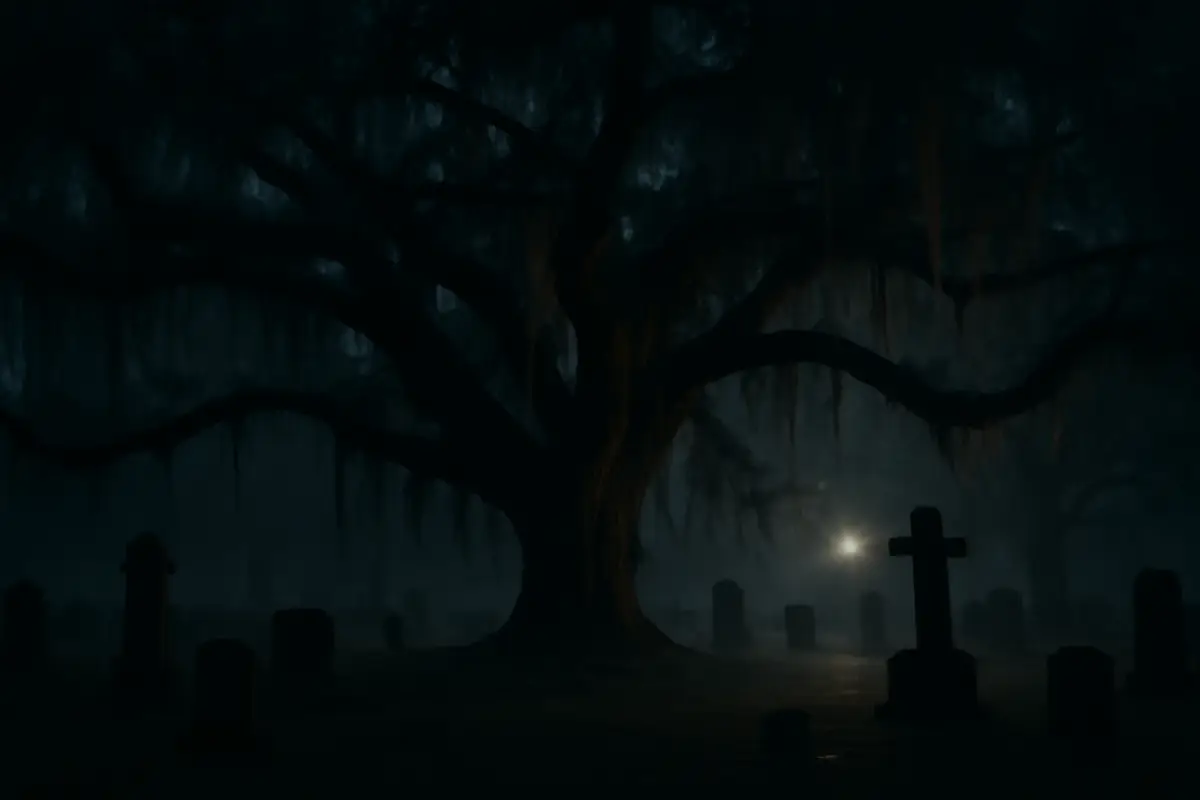
In the northwest corner of Mobile, Alabama's Church Street Graveyard stands a large, unusually positioned live oak — one that, according to an 1835 death-row prophecy, sprouted directly from the heart of a man executed for a murder he swore to the gallows he did not commit.
The Real History
Charles R. S. Boyington arrived in Mobile from Connecticut in 1833, working as a printer and reportedly known around the city as a frequent gambler. He roomed with a fellow young man, Nathaniel Frost. On May 11, 1834, the two were seen leaving together for a walk toward Church Street Graveyard, then on the outskirts of the city. Frost was later found dead nearby, stabbed and robbed.
Boyington, the last person seen with Frost and the obvious suspect, was tried and convicted of the murder — largely on circumstantial evidence, since there were no eyewitnesses to the killing itself. He maintained his innocence throughout the trial and up to his execution. Mobile carried out the hanging on February 20, 1835, making it one of the city's most publicized 19th-century capital cases. Because he had been convicted of murder, Boyington was denied burial in consecrated cemetery ground and was instead interred in the potter's field section in the graveyard's northwest corner.
Historical accounts consistently record that, from the gallows, Boyington declared his innocence and predicted that an oak tree “with a hundred roots” would grow from his grave as proof he had been wrongly convicted. Within a matter of years, a live oak was indeed growing at the site — a real, verifiable tree that still stands in Church Street Graveyard today, nearly two centuries later, now among the largest and oldest oaks in the cemetery.
Whether Frost's actual killer was ever identified remains, by most historical accounts, unresolved — no alternative suspect was ever convicted, and the case is frequently cited by Mobile historians as a probable wrongful execution.
The Haunting
Local legend holds that the Boyington Oak is the physical manifestation of Charles Boyington's protest of innocence — and that his spirit still lingers at the base of the tree. Visitors and ghost tour guides in Mobile say they've heard whispering or crying near the tree after dark, particularly around the anniversary of the execution, and some report a cold, watching presence or fleeting shadowy figures near the trunk.
None of these accounts are independently documented beyond oral tradition and modern ghost-tour testimony, but the story's persistence — tied as it is to a real trial, a real execution date, and a real, still-living tree — has made it one of the most consistently repeated haunted legends in the American South.
Can You Visit?
Yes. Church Street Graveyard is a historic public cemetery in downtown Mobile, Alabama, and the Boyington Oak is one of its most visited landmarks, accessible during the cemetery's open hours. It is also a regular stop on Mobile's commercial ghost tours.
Frequently Asked Questions
Did Charles Boyington actually predict the tree?
Multiple historical accounts of his 1835 execution record him declaring that an oak would grow from his grave to prove his innocence. A live oak matching that description is documented to have grown at the burial site not long after.
Was Charles Boyington guilty?
It's unresolved. He was convicted on circumstantial evidence with no direct eyewitness to the murder, and no alternative suspect was ever identified or convicted.
As an Amazon Associate, this site earns from qualifying purchases.