
- Native
- Nisse (Danish/Norwegian), Tomte (Swedish), Tonttu (Finnish)
- Type
- Household and farm guardian spirit
- Region
- Scandinavia (Denmark, Norway, Sweden)
- Verification
- Oral tradition

The nisse is the household spirit of Danish and Norwegian farms, called the tomte in Swedish. He is a small figure in grey with a red cap who looks after the animals at night, and who expects a bowl of porridge with butter on it at Christmas. In the stories folklorists wrote down, he is a protector with a short temper, not a gift-bringer. The jolly Christmas gnome is a later arrival.
In the record
- J. M. Thiele collected and published Danish nisse stories in Danske Folkesagn (1819 to 1823), according to the Danish encyclopedia Lex.
- Wikipedia cites Faye (1833), Afzelius (1844) and Olrik and Ellekilde (1926) for descriptions of the nisse and tomte as small, grey-clad figures in red caps.
- Viktor Rydberg’s poem “Tomten” appeared in 1881 in the magazine Ny Illustrerad Tidning, with a title illustration by Jenny Nyström.
- Sweden’s National Museum says Nyström is considered the first to give the Swedish jultomte his look and character.
Not in the record
- Whether the belief is older than the written sources, and by how much.
- Any single origin: ghost of the first settler, ancestral guardian, or a pet form of the name Niels.
- The tales of cows killed over hidden butter, which are stories, not events.
What Is the Nisse?
The nisse is a farmstead spirit, known as nisse in Denmark and Norway, tomte in Sweden and tonttu in Finland. Lex describes him as a small, older bachelor in grey clothing and a red pointed cap, and says each farm had only one. Wikipedia lists regional names too: tufte and tuftekall in parts of Norway, and goanisse, “good nisse”, in Scania, Halland and Blekinge in Sweden.
His size depends on who is describing him. Faye (1833) made the Norwegian nisse no bigger than a child. Afzelius (1844) put the Swedish tomte at about the size of a one-year-old, with an old man's wrinkled face. Olrik and Ellekilde, writing in 1926, say the traditional Danish nisse had no beard, like a child, and that a bearded nisse is a later change. That detail matters when you meet the white-bearded figure on a Christmas card.
The Farm Guardian
According to Lex, the nisse lived in the barn loft or above the stable. He was strong, fast, able to take animal form, and laughed like a neighing horse. Wikipedia, summarising the collectors, says a well-treated tomte protected the family and the animals.
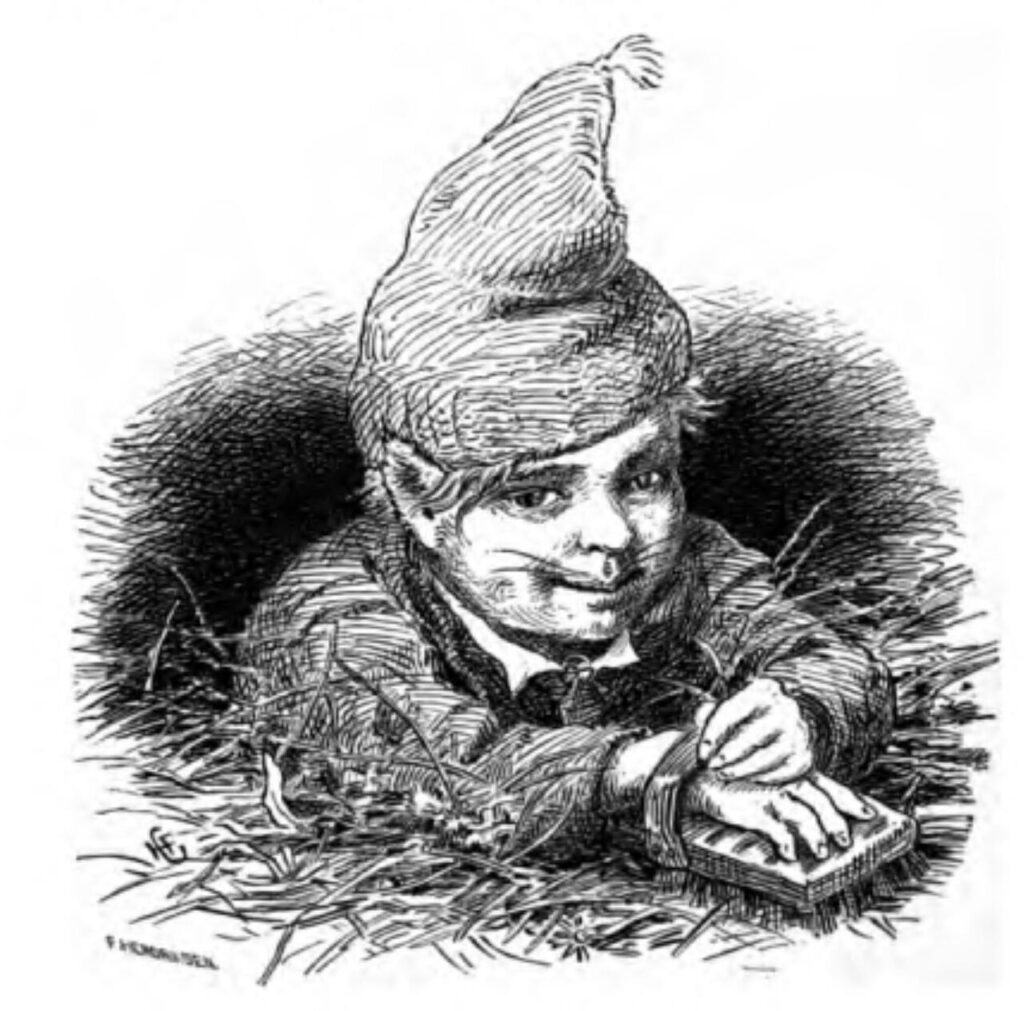
The work was practical. Norwegian tradition, per Wikipedia, has the nisse stealing hay from neighbours for the farmer's favourite horse; Danish tradition has him stealing grain. Stable hands were expected to feed the horses at four in the morning and ten at night, or risk a beating. A horse mane found braided into knots was called a nisse-plait, taken as a sign he had been there.
He was easy to offend. Rudeness, swearing and urinating in the barn are the offences Wikipedia lists. The punishments run from spilled milk and soured cream to broken harness straps and dead livestock. An angry nisse could leave, and the farm's luck went with him. Compare the Russian domovoi, a household guardian spirit from a neighbouring tradition.
The Christmas Porridge
The nisse's pay was porridge. Lex says he stayed helpful when given a bowl of sweet porridge with a pat of butter, served on Saturday evenings and on holidays. The Christmas Eve bowl is the version that survived into the present. In Norway, Wikipedia says, rømmegrøt (sour cream porridge) was favoured, and rice pudding later became the usual choice.
The butter is the point of the best-known story. A farmer hides the butter under the porridge. The offended nisse kills the cow. Then he finds the butter at the bottom of the bowl, is sorry, and replaces the cow with an identical one from another farm. Wikipedia retells this as a widely told tale, and the Arctic Portal gives the same plot, without naming a collector for it.
Hans Christian Andersen used the custom in a tale from the early 1850s, The Goblin at the Grocer's. A grocer gives his nisse Christmas porridge with a large lump of butter, and the nisse stays loyal to the grocer for the jam, even when a student's poetry book tempts him away. It is a literary story built on a folk custom. Do not read it as a record of belief.
Where the Name and the Belief Come From
No one agrees. Wikipedia lists several proposals. Jacob Grimm held that nisse is a form of Niels, related to Nicholas, and the Danish pet name “Lille Niels” supports that reading. Lex also calls the name a pet form of Niels. Ottar Grønvik (1997) proposed an Old Norse word meaning “dear little relative”. Feilberg (1904 and 1918) argued that the spirit blends a nature spirit with the ghost of the first person to clear the land.
On how old the belief is, scholars differ. Wikipedia cites Emil Birkeli (1938) for the thirteenth or fourteenth century and Christiansen (2016) for the seventeenth, and notes a Norwegian legal tract of about 1600 that mentions “Nisse pugen”. Lex says the idea of pre-Christian household guardians has no firm evidence in the Nordic countries, though it compares Roman household figurines. Treat the deep-origin stories as scholarly theories only. The earliest picture many cite is a 1555 woodcut by Olaus Magnus showing a stable worker, which Wikipedia says is probably a tomte.
From Farm Spirit to Christmas Gnome
The change is documented, and it happened in the nineteenth century. Lex says the first recorded Christmas nisse appeared at a party given by the painter Constantin Hansen in 1836, and that artists then gave him the job of bringing presents. Wikipedia places the Danish artists Lorenz Frølich (1840), Johan Thomas Lundbye (1845) and H. C. Ley (1849) in the same shift. The sources do not agree on the first date, which is a reason to say “the 1830s and 1840s” and stop there.
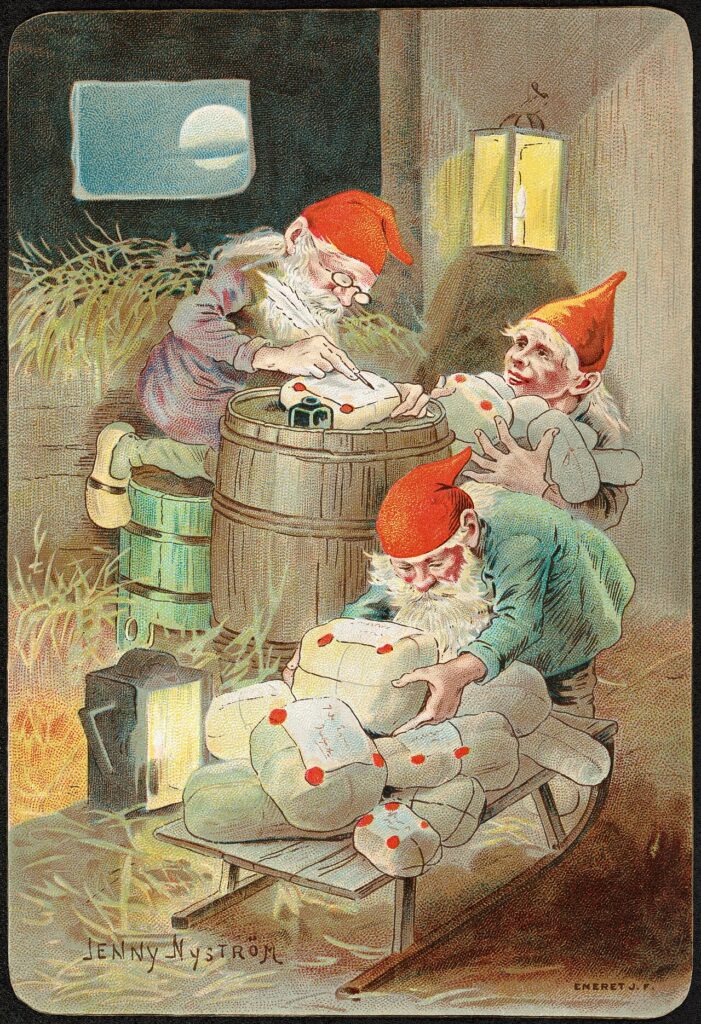
In Sweden the image comes through Rydberg and Nyström. Rydberg's “Tomten” (1881) opens “Midvinternattens köld är hård”, the cold of midwinter night. In the poem the tomte walks the farm while everyone sleeps, looks in on the animals and the sleeping children, and cannot answer a question about where human lives come from and where they go. He is a guardian watching, not a giver. Nyström's Swedish jultomte pictures, per the National Museum, set the look, and Wikipedia says her 1881 illustration is credited with the white-bearded, red-capped image. Wikipedia adds that von Sydow blamed English Father Christmas cards, while Nyström denied any foreign influence. Another Wikipedia claim says Swedish gifts were once the work of the Yule goat, the julbock, before the jultomte.
The garden gnome is a further step. Wikipedia says it resembles the traditional tomte and goes by trädgårdstomte in Swedish and havenisse in Danish. For Christmas-season figures from Iceland, see Gryla and the Yule Lads and the Yule Cat.
How Much Is Documented
The collecting is documented: Thiele, Faye, Afzelius and Feilberg all wrote down what people told them, and the nineteenth-century poems and pictures can be dated. What cannot be checked is how old the farm belief is, how widely each detail was held, and whether anyone left porridge out because of a particular story or only out of habit. The porridge custom is better described as a tradition recorded in folklore than as a verified practice from any given century.
Frequently Asked Questions
What is a nisse?
A nisse is a household and farm spirit in Danish and Norwegian folklore, called a tomte in Sweden. He is usually described as a small figure in grey with a red cap who guards the animals and expects Christmas porridge with butter.
Is the nisse the same as the tomte?
They are the same kind of being under different names. Wikipedia lists nisse for Denmark and Norway and tomte for Sweden, with tonttu as the Finnish form borrowed from Swedish.
Why do people leave porridge with butter for the nisse?
In the folklore, the bowl is payment for a year of protection. A nisse who was neglected could spill milk, harm the animals or leave the farm. The butter tale shows he judged the bowl by what was in it.
Did Viktor Rydberg invent the tomte?
No. Rydberg's poem “Tomten” was published in 1881, long after collectors like Thiele and Faye wrote down the farm spirit. The poem and Jenny Nyström's illustration shaped the later Christmas image in Sweden.
Did the nisse always have a white beard?
Not in the older Danish descriptions. Olrik and Ellekilde say the traditional Danish nisse was beardless, and a beard was a later alteration.
Is the nisse a real historical being?
No. He belongs to folklore. The collecting of the stories is documented, but the belief itself rests on oral tradition.


Comments