- Native
- An Ankoù
- Type
- Folklore death figure
- Region
- Brittany
- Verification
- Oral tradition

The Ankou is the figure Breton folklore sends to collect the dead: a figure in a black robe and wide hat, a scythe over the shoulder, a creaking cart rolling toward the house where someone is about to die. The best-known twist is that the role is not held by one fixed being. In the tradition collected by the Breton folklorist Anatole Le Braz, the last person to die in a parish each year takes the job for the following year.
In the record
- Wikipedia describes the Ankou as a servant of death in Breton, Cornish and Welsh mythology (an Ankow in Cornish, yr Angau in Welsh).
- Anatole Le Braz (1859 to 1926), a Breton poet and folklore collector, published La Légende de la mort en Basse-Bretagne in 1893, with an expanded edition in 1902, according to Wikipedia.
- The folklorist Walter Evans-Wentz wrote about the Ankou in The Fairy Faith in Celtic Countries (1911), as cited by the Atlantic Religion blog.
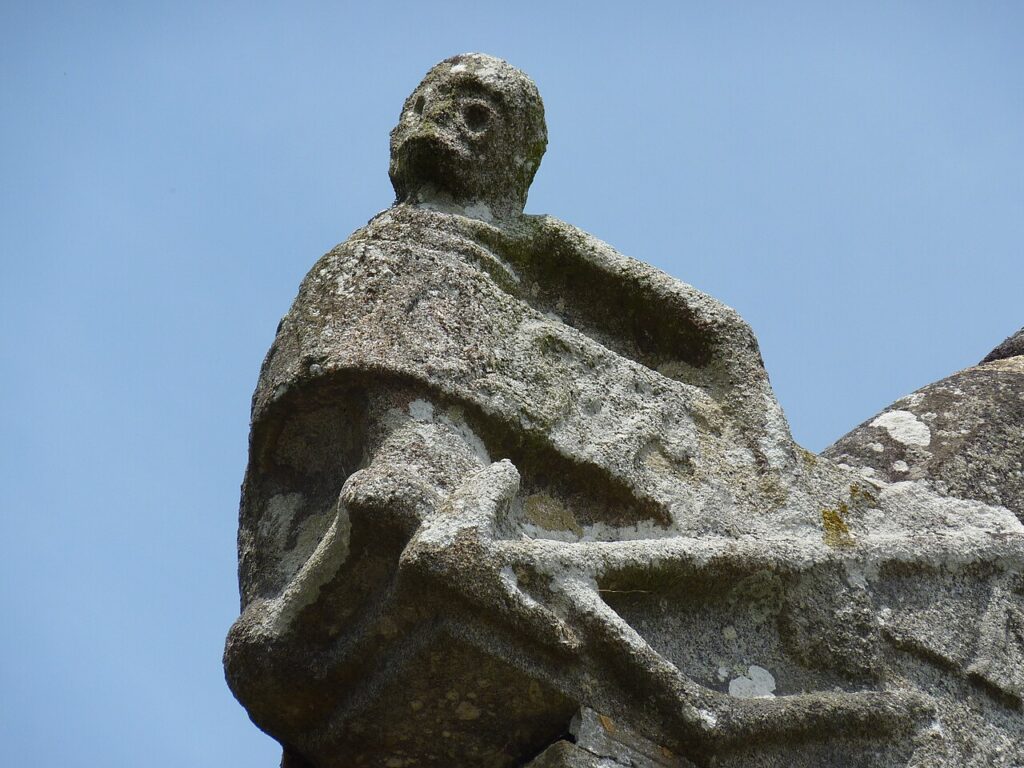
- A carving of the Ankou holding a human head is reported on the baptismal font at La Martyre, according to Wikipedia, and another on the ossuary of the chapel at Ploudiry, according to Atlantic Religion.
Folk belief, not record
- The Ankou’s cart, scythe and black horses. These come from oral tradition and later retellings.
- The belief that each parish has its own Ankou, the last person to die there that year.
- Every origin story, including the cursed prince and the first dead person of the year.
What the Ankou Looks Like
Wikipedia says the Ankou appears as a man or a skeleton in a black robe, with a large hat that hides the face, or sometimes only as a shadow. He carries a scythe. Accounts put him on a cart for collecting the dead, or driving a large black coach pulled by four black horses, with two ghostly figures walking beside it.
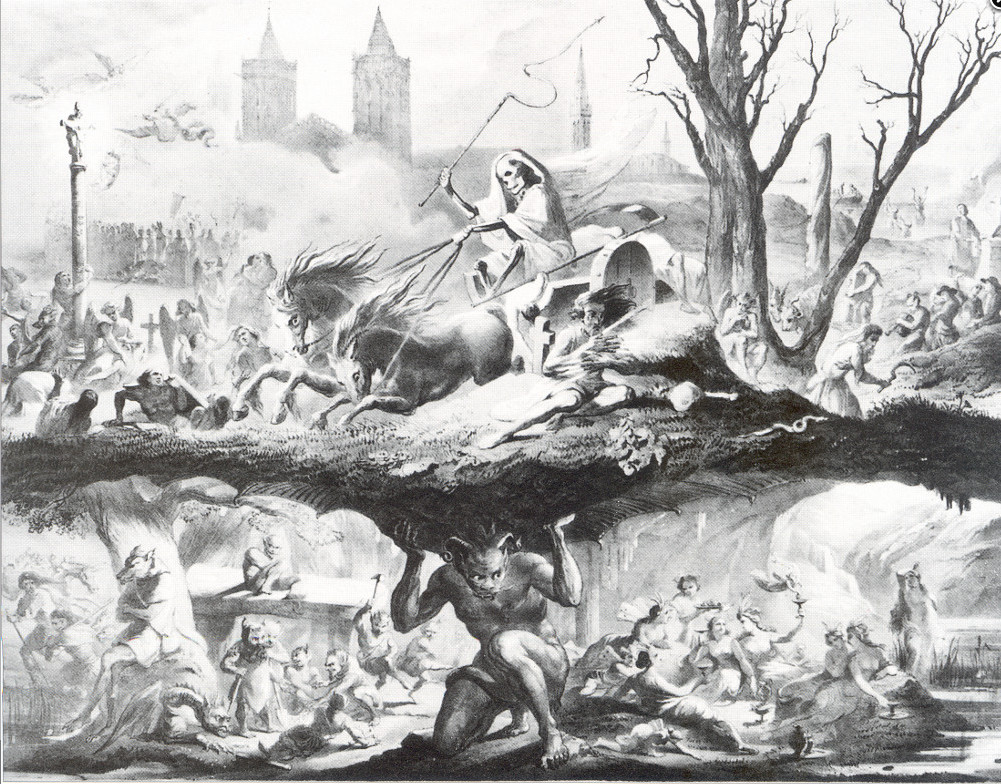
These pictures are folk tradition. The sources opened for this article do not agree on every detail, and the fullest descriptions come from nineteenth and early twentieth century collectors writing down what villagers told them.
The Job Passes Down the Parish
Le Braz, quoted by Wikipedia, calls the Ankou the henchman of Death, known in Breton as oberour ar maro. He is also described as a watcher of the graveyard who guards the souls around it and gathers the ones left wandering on his land.
Then comes the rotating rule. According to Le Braz, the last person to die in a parish in a given year becomes the Ankou of that parish for the whole of the next. Evans-Wentz repeats the idea in 1911, saying every parish in the less changed parts of Brittany has its own Ankou. The Atlantic Religion essay notes that he leaned on Le Braz for this.
A year with more deaths than usual had its own saying. Wikipedia quotes Le Braz as recording the Breton remark that this one is “a nasty Ankou”. The saying blames a bad year on whoever is serving.
Sounds That Warned of Him
Wikipedia lists two omens. Squealing wheels outside the house were taken to be the Ankou's cart, called Karrigell an Ankou. The cry of an owl was called Labous an Ankou, the death bird. These belong to the same family as the omens in other European traditions. For a cousin from Ireland, see the Banshee, and for another figure on a death-bringing ride, the Dullahan.
Where the Origin Stories Disagree
There is no single origin. Wikipedia mentions several, without citing a source for them. One says the Ankou is the first person to die in a year, who must collect other souls before moving on. Another tells of a cruel prince who met Death on a hunting trip and challenged him to a contest over who could kill a black stag first. Death won, and the prince was condemned to wander the earth for ever. Treat these as variants told by different people, not as one authoritative version.
The Atlantic Religion essay is also cautious about the name. It says the explanation that Ankou means “agony” is speculative.
Stone Faces in Brittany
The Ankou is one of the few folklore figures you can look at in stone. The Ploudiry ossuary carving mentioned by Atlantic Religion shows him holding a weapon, which the essay calls an elf-arrow. Wikipedia places an Ankou on the La Martyre font holding a human head. If you visit Brittany, check opening hours and access for these parish sites before you go, because this guide did not confirm current visiting arrangements.
Echoes Elsewhere
Atlantic Religion compares the Ankou with the Highland Scottish Faire Chloidh, the “grave watch”, recorded by Donald MacPherson in 1824. In that tradition the last person buried stands guard at the graveyard gate from sunset to cockcrow. It is a parallel the essay draws, not a proven link. The same essay's wilder guesses, such as tying the Ankou to the Wild Hunt, are the author's own speculation.
How Much Is Documented
The collecting is documented. Le Braz published his material in the 1890s, and Evans-Wentz cited it in 1911. What cannot be checked is how old the belief is or how widely it was held. Everything here comes from collectors, so what survives is their selection of what villagers said, often in translation.
Frequently Asked Questions
What is the Ankou?
The Ankou is a figure of death in Breton folklore who collects the souls of the dead. Wikipedia also records versions in Cornish and Welsh tradition. He is usually pictured in a black robe with a scythe and a cart.
Who becomes the Ankou?
According to Le Braz, the last person to die in a parish during the year becomes its Ankou for the following year. Evans-Wentz repeated the idea in 1911.
What are the warning signs of the Ankou?
Wikipedia lists squealing wheels outside the house, thought to be the Ankou's cart, and the cry of an owl, called the death bird.
Is the Ankou a real historical figure?
No. He is a folklore character. The collecting of the stories by Le Braz is documented, but the belief itself rests on oral tradition.
Where can you see the Ankou in Brittany?
Carvings are reported on the baptismal font at La Martyre and on the ossuary at Ploudiry. Check current access before visiting.
Is the Ankou the same as the Dullahan?
No. The Dullahan is a headless rider from Irish tradition. The two are often compared as death-bringers on a ride, but they come from different traditions.