- Native
- Huldra / Hulder (Norwegian), Skogsrå (Swedish)
- Type
- Forest woman / seductive folk-belief being
- Region
- Scandinavia (Norway, Sweden)
- Verification
- Partially documented
The huldra is a female being of Norwegian folk belief, known in Sweden as the skogsrå. She is beautiful and tall from the front, but she has a cow's tail or a hollow back, and she keeps both out of sight. In the stories she lures men into the forest, and she can be generous or dangerous depending on how she is treated. This is a Scandinavian tradition. The Icelandic huldufolk are a separate one.
In the record
- Store norske leksikon (SNL) describes the huldra as a female being of Norwegian folk belief with a hollow back and a cow’s tail, and lists Asbjørnsen and Moe’s huldre tales as the best-known collection.
- Asbjørnsen and Moe’s first Norske Folkeeventyr appeared in 1842 to 1843; Asbjørnsen’s Huldre-Eventyr og Folkesagn followed in 1845, per Wikipedia.
- The Swedish skogsrå is described in the Swedish Wikipedia entry, which cites the Institute for Language and Folklore (Isof) and Rietz’s dialect dictionary of 1862 to 1867.
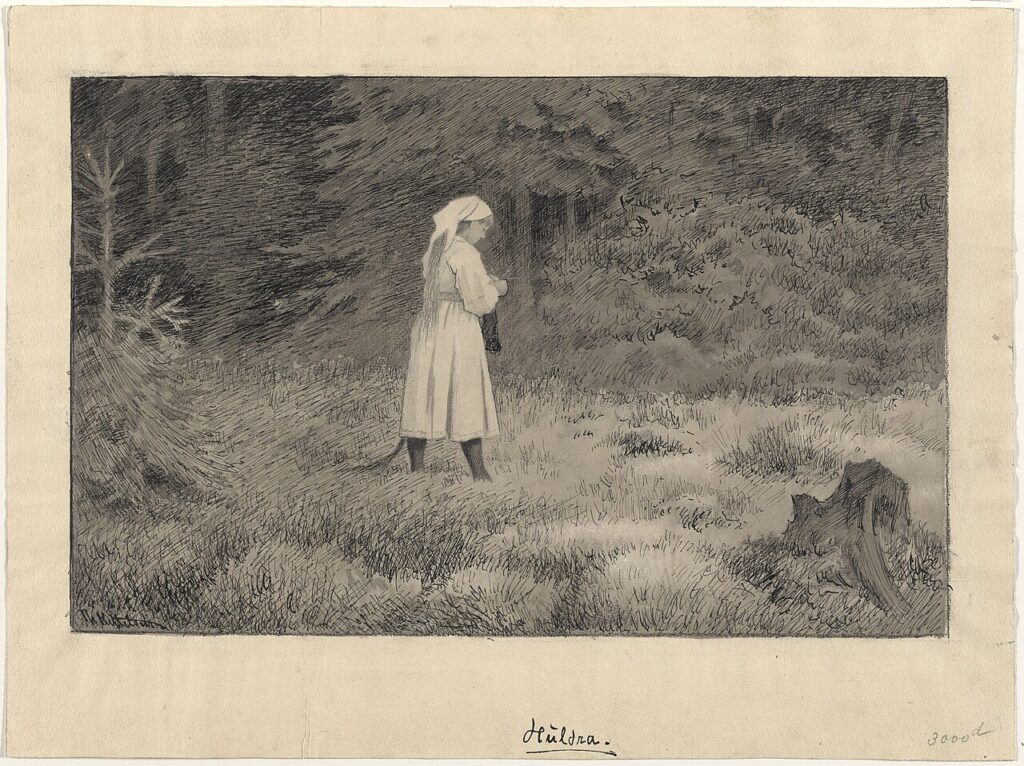
- Theodor Kittelsen made the drawing Huldra forsvant in 1908, according to SNL.
Not in the record
- Any real woman or event behind the figure.
- How old the belief is before the nineteenth-century collecting.
- The claimed link to Old Norse Huld or German Holda, which Wikipedia flags as needing a better source.
What Is the Huldra?
In Norwegian the word is huldra (also hulder). SNL says she is “stronger and prettier” than human women, tall and fair, with a lovely voice, but with a hollow back and a cow's tail. She is usually met alone, yet she belongs to a community called the huldrefolk, also known as de underjordiske, the underground people. SNL derives the name from Old Norse hylja, “to hide”. That fits her: the tail and the back are exactly what she hides.
Wikipedia adds a male counterpart, the huldrekall, and notes the folklore assumes a whole race of huldre rather than a single woman.
Her Names Across Scandinavia
Swedish tradition uses different words. Wikipedia lists skogsrå (“forest spirit”) and tallemaja (“pine tree Mary”). Swedish Wikipedia adds skogsfrun, skogsjungfrun, huldran, and Talle-Maja.
The tail varies with the region. In the northern Swedish areas, Swedish Wikipedia says she looks like an ordinary woman from behind but has a cow's or horse's tail, sometimes a fox's. Further south, in Götaland and south-eastern Svealand, she is lovely from the front but hollow behind, like an old tree trunk, and takes care to show only her good side. The Norwegian huldra is the version with both features in SNL's wording.
How She Behaves
SNL lists the motifs. She seduces, with a voice that calls people in. People walking near the forest could be bergtatt, “taken into the mountain”, lured in and held. Men alone in the outfields were at the most risk, according to SNL. Someone who escaped might lose his wits or fall seriously ill.
She also rules the wild. SNL says the huldre decide over the animals of forest and mountain, and people asked permission before settling in a summer farm. Her cattle, the huldrekyr, are described as larger and better kept than ordinary cows. Dairymaids on the summer farm were advised to spill a little milk on the barn floor and set aside a stall for her cow, and were rewarded with plenty of butter and cheese.
In Swedish tradition the contexts include hunters and charcoal burners. Swedish Wikipedia says she may dance around a hunter's campfire, and that she was said to wake the charcoal burner when his kiln was burning, a belief most common in Bergslagen. English Wikipedia says huldre were considered kind to charcoal burners, who left provisions in a special place for her. A man who slept with her could turn silent and withdrawn, “as if his soul stayed with her”.
Where the Stories Were Written Down
The tales were collected in the nineteenth century. Peter Christen Asbjørnsen and Jørgen Moe published Norske Folkeeventyr from 1842 to 1843, and Asbjørnsen brought out Huldre-Eventyr og Folkesagn in 1845, according to Wikipedia. SNL calls the huldre-tale collection (Norske Huldre-Eventyr og Folkesagn) the best known and credits it to “Asbjørnsen og Moe”; Wikipedia says Asbjørnsen published it alone. The sources differ on authorship, so credit Asbjørnsen at minimum.
For Sweden, Swedish Wikipedia points to Isof and to Gunnar Granberg's 1935 study of the skogsrå, which it lists among further reading.
Art and Later Use
Picture and page carried her on. SNL lists a Theodor Kittelsen drawing, En hulder som strikker (“A hulder knitting”), from Troldskab (1891 to 1892), and Huldra forsvant (“The huldra vanished”, 1908). It also credits Hans Gude with a drawing for Asbjørnsen's huldre tale En aftenstund i et proprietærkjøkken (1878). The same article mentions Ibsen's Peer Gynt and Garborg's Haugtussa as literary uses, and the 2012 Norwegian film Thale, about a captured hulder. These are works of art and fiction, not records of belief. No fetched source supports a pop-culture link beyond these, so none is claimed.
For a neighbouring tradition, see the nisse and tomte, the farm spirit that shares her Scandinavian setting, and the gjenganger, Norway's walking dead.
How Much Is Documented
The collecting and the artworks are documented, and they can be dated. The belief itself is oral tradition: nobody has checked it, and nobody can say how many people held it or how literally. The details also differ by region, so “the huldra” is a pattern across tellers, not one fixed being.
Frequently Asked Questions
What is a huldra?
A huldra is a seductive female being in Norwegian folklore who looks like a beautiful woman but has a cow's tail or a hollow back. She is part of the huldrefolk, the underground people. In Sweden the closest figure is the skogsrå.
Why does the huldra have a cow's tail?
The sources describe the tail as a given feature and give no explanation. SNL files the cow's tail alongside the huldrekyr, her cattle, as a motif, but gives no origin.
Is the huldra the same as the Icelandic huldufólk?
No. The names sound alike, but the Icelandic huldufólk are a separate tradition of hidden people. Wikipedia lists them as the Icelandic and Faroese counterpart, not the same figure.
What is the Swedish version of the huldra?
The skogsrå, also called skogsfrun or tallemaja. Swedish Wikipedia describes a forest ruler with a tail or a hollow back who lures travellers and wakes charcoal burners.
Who recorded the huldra stories?
Peter Christen Asbjørnsen and Jørgen Moe collected Norwegian folktales from 1842, and Asbjørnsen published Huldre-Eventyr og Folkesagn in 1845. Swedish Wikipedia cites Isof and Rietz's dictionary for the skogsrå.
Is the huldra real?
No. She belongs to folklore. The collecting is documented, but there is no evidence of an actual being.

Comments