This article contains affiliate links. If you buy through them, we may earn a commission at no extra cost to you.
Hiwasa Tunnel (日和佐トンネル) is a real road tunnel on National Route 55 in Minami Town, Tokushima Prefecture, Shikoku — about 690 meters long, completed in 1970, and still in active use.
- The legend
- What investigation has found
- Our take
- The Phone-Booth Ghost Story Genre
- Part of a Wider Pattern: Haunted Tunnels Across Japan
- Frequently Asked Questions
- Does the phone at Hiwasa Tunnel actually ring?
- Has anyone died near Hiwasa Tunnel?
- When was Hiwasa Tunnel built?
- Is the phone booth from the legend still there?
- What are the “fireballs” people report seeing?
- Why are so many tunnels in Japan considered haunted?
- Is Japan considered a haunted country?
- What makes an abandoned tunnel a likely setting for a ghost story in Japan?
- Related Stories
The legend
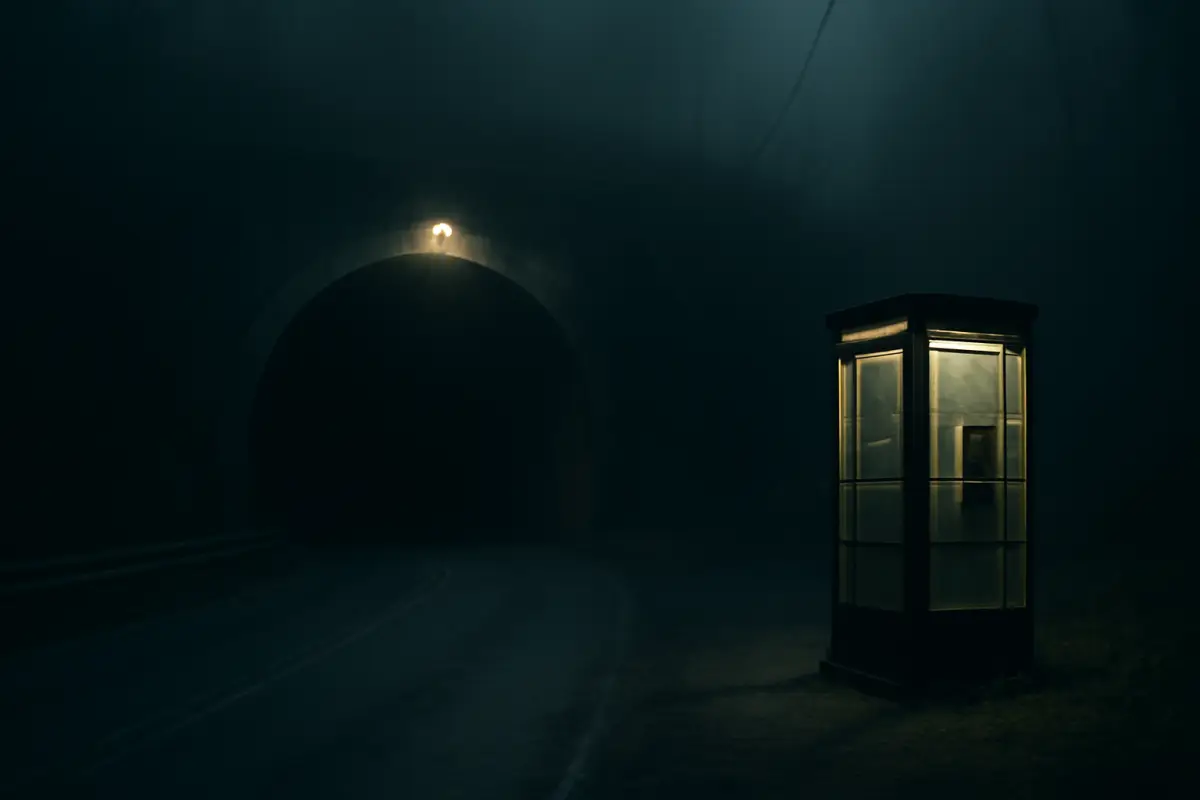
The ghost story centers on a public telephone booth near the tunnel's exit. Local legend holds that late at night the phone rings, and answering callers hear a man's groaning voice. Some versions add a call-back to the caller's own mobile from an unknown number, repeating the groan. The tunnel is also said to host drifting “fireballs” and a pale floating figure.
What investigation has found
A Japanese paranormal-investigation blog that visited the site reported a mundane explanation: fireflies inhabit the area in summer, a plausible source for “fireball” reports. The same visit found no floating spirit and the phone did not ring. We found no documented death or accident tied to the tunnel or booth that would explain the story's origin.
Our take
A genuine 1970s highway tunnel with a well-documented piece of local folklore attached — but with a plausible mundane explanation for at least one commonly cited effect, and no substantiated tragedy behind it.
Can you visit: Yes. It is on active National Route 55.
The Phone-Booth Ghost Story Genre
A ringing public phone with no one on the other end, or a voice that shouldn’t exist, is a recurring motif across Japanese ghost stories, tied to public phone booths’ role as an unmonitored point of contact from a stranger. Hiwasa Tunnel’s version follows the pattern closely enough that its most vivid detail — a callback to the caller’s own mobile — matches similar reports attached to other Japanese phone-booth legends, suggesting shared storytelling conventions rather than a fully independent origin.
Part of a Wider Pattern: Haunted Tunnels Across Japan
Hiwasa Tunnel, Tokushima is one of dozens of similar sites documented across this site, and it fits a recognizable pattern rather than standing alone. Roughly three-quarters of Japan’s land area is mountainous, which has required over a century of tunnel construction, and older bores are typically sealed or abandoned rather than demolished once a wider, better-lit replacement opens nearby. Those abandoned alignments — not the tunnels still in daily use — are where the folklore tends to concentrate: narrow, unlit, and left to decay in a way that reads as ominous even when the underlying cause is a routine highway upgrade. Japan’s long kaidan (ghost story) storytelling tradition, which attaches spirits to liminal spaces such as tunnels, bridges, and mountain passes, gives these sites a ready-made narrative frame.
Frequently Asked Questions
Does the phone at Hiwasa Tunnel actually ring?
A paranormal-investigation blog that visited found no ringing during their visit and identified fireflies, common in the area in summer, as a likely source of “fireball” sightings.
Has anyone died near Hiwasa Tunnel?
We found no documented death or accident tied to the tunnel or the phone booth that would explain the story’s origin.
When was Hiwasa Tunnel built?
1970, as part of National Route 55 on Shikoku — it remains in active daily use.
Is the phone booth from the legend still there?
Public phone booths have become increasingly rare across rural Japan in general, and we could not confirm the specific booth’s current status — a detail worth checking locally if you’re visiting for the legend rather than assuming it’s unchanged.
What are the “fireballs” people report seeing?
A local paranormal-investigation blog attributed them to fireflies, which are common in the area during summer months — a mundane explanation that predates and likely outlasts the supernatural framing.
Why are so many tunnels in Japan considered haunted?
Japan’s mountainous terrain (roughly three-quarters of the country) has required over a century of tunnel construction, and old bores are typically abandoned rather than removed once a newer route opens nearby. Combined with a long kaidan (ghost story) tradition of attaching spirits to liminal spaces, these abandoned tunnels became natural settings for local ghost stories.
Is Japan considered a haunted country?
Japan has one of the world’s richest documented traditions of ghost stories and haunted-location folklore, built up over centuries through kaidan storytelling, yokai folklore, and site-specific legends attached to tunnels, forests, and other liminal places. That reflects a deep cultural and narrative tradition — not a verifiable claim about supernatural activity.
What makes an abandoned tunnel a likely setting for a ghost story in Japan?
Age, disuse, and physical decay do most of the work: a dark, damp, overgrown structure that once carried traffic and now carries none reads as unsettling on its own, independent of any specific incident. As with Hiwasa Tunnel, Tokushima, the underlying history is often more mundane — a routine bypass or road realignment — than the legend suggests.
As an Amazon Associate, this site earns from qualifying purchases.