This article contains affiliate links. If you buy through them, we may earn a commission at no extra cost to you.
Most explanations of where Halloween “really” comes from repeat the same handful of claims — some accurate, some traced to a single 18th-century writer with an agenda that had nothing to do with folklore. Here's what historians and Celtic-studies scholars actually document about Samhain, and where the widely repeated version of the story goes wrong. For dates, events, and everything else to know this season, see our Halloween 2026 guide.
Samhain Was a Festival, Not a Death God
The single most common myth about Samhain is that it was a Celtic god of death or darkness. According to researchers who have traced the claim, this idea does not appear anywhere in the pre-Christian Irish record. It originates instead with Charles Vallancey, an 18th-century British army officer and amateur antiquarian who argued — incorrectly — that the Irish descended from Armenians, and who invented a supposed death-god called “Balsab” as part of that theory. Historians and folklorists have since dismissed Vallancey's scholarship, but the “Samhain the death god” version kept circulating in later retellings and is still repeated in some Halloween coverage today.
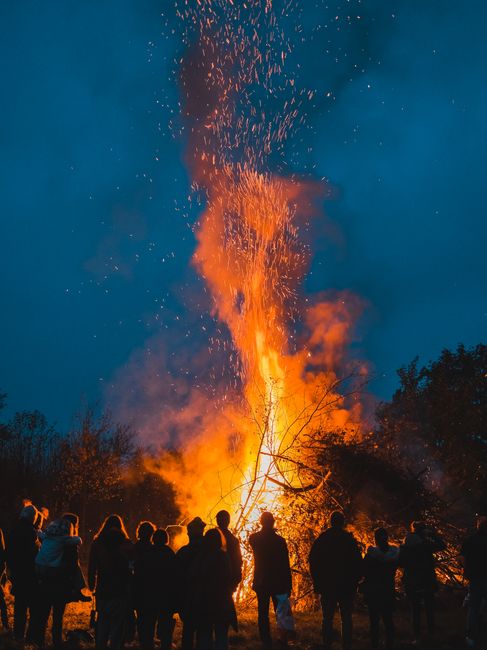
What Samhain actually was, according to sources including Britannica and the Celtic-studies literature: one of four seasonal fire festivals in the pre-Christian Gaelic calendar (alongside Imbolc, Beltane, and Lughnasadh), marking the division between the “lighter half” of the year (summer) and the “darker half” (winter). It fell at the midpoint between the autumn equinox and the winter solstice — roughly October 31 to November 1 — and functioned as something close to a new year's turning point, since it marked the end of the harvest and the start of winter.
What Ancient Irish Sources Actually Describe
Early Irish texts describe Samhain as a mandatory, multi-day gathering — accounts mention three days and three nights — during which communities were expected to present themselves before local kings or chieftains, with failure to attend said to bring misfortune from the gods. The belief most consistently attached to Samhain across these sources is that the boundary between the world of the living and the otherworld grew thin on that night, allowing spirits — including the spirits of one's own ancestors — to cross over. Households are described as honoring and welcoming their dead while also taking precautions against more hostile spirits.
It's worth being honest about the limits here: most of what survives about Samhain was written down centuries later by Christian monks recording older oral tradition, so some details reflect medieval interpretation as much as pre-Christian practice. Historians tend to flag that distinction rather than treat every surviving detail as a direct window into Iron Age belief.
How Samhain Connects — and Doesn't Connect — to Halloween
The link between Samhain and modern Halloween is itself a subject of real scholarly disagreement, not settled fact. The throughline most people know — pagan Samhain absorbed into the Christian calendar as All Hallows' Eve — was largely constructed by 19th-century folklorists, including Oxford's John Rhys and Cambridge's James Frazer, who were working within a broader Victorian project of tracing modern customs back to supposed pagan survivals.
On the Christian side, Pope Gregory III is credited, in at least some historical accounts, with dedicating an oratory in St. Peter's Basilica to all the saints on November 1 during his 8th-century papacy, helping establish that date for the Feast of All Saints in Rome. The evening before became All Hallows' Eve — the phrase that eventually contracted into “Halloween.” Some historians argue the Church positioned the date to fold in existing autumn festivals like Samhain; others note the date's own church history complicates any claim that it was simply copied from Samhain. Both positions appear in serious historical writing, and this article isn't resolving that debate — it's citing it as a live disagreement.
The Jack-o'-Lantern Started as a Turnip, Not a Pumpkin
One piece of Halloween folklore that is more consistently documented: the jack-o'-lantern traces to an Irish folk tale about “Stingy Jack,” a man who tricked the Devil and was consequently barred from both heaven and hell, left to wander in darkness with only a burning coal — which, in the story, he carried inside a hollowed-out turnip. Irish and Scottish communities are said to have carved their own frightening faces into turnips and beets around Samhain and All Hallows' Eve, setting them in windows or by doors to ward off Stingy Jack and other wandering spirits.
When Irish immigrants brought the custom to North America in the 19th century, they found a much larger, easier-to-carve gourd already growing locally — the pumpkin — and the jack-o'-lantern as most people picture it today was born from that substitution rather than from any older pumpkin-carving tradition in Ireland itself.
Trick-or-Treating Has Its Own, Separate History
Trick-or-treating didn't descend directly from Samhain rituals either — its more immediate roots are in “souling” and “guising,” practices documented in Britain and Ireland around All Souls' Day, where poor people or costumed children went door to door offering prayers, songs, or a performed “trick” in exchange for food, coins, or soul cakes. Irish and Scottish immigrant communities revived versions of these customs in the United States in the early 20th century, and the earliest known print use of the phrase “tricks or treats” is documented from 1917 in Ontario, Canada. Community-organized trick-or-treating as a widespread American practice is generally dated to the 1930s, partly as a response to a wave of destructive Halloween pranking during the Depression era that towns were actively trying to redirect into something safer.
Frequently Asked Questions
Was Samhain really the Celtic new year?
It's widely described that way in popular sources, and the festival did mark the transition from the harvest season into winter — functioning similarly to a year's turning point — though whether the pre-Christian Irish literally counted it as "New Year's Day" in a formal calendrical sense is less certain than the popular framing suggests.
Did the Catholic Church invent Halloween specifically to replace Samhain?
This is disputed among historians. Some argue the Church positioned All Saints' Day and All Hallows' Eve to absorb existing pagan autumn observances; others point out that the November 1 date has its own documented Christian history that developed somewhat independently. Both views appear in serious scholarship, and no single source settles it definitively.
Is there real evidence that ancient Celts believed the dead could return on Samhain?
Yes — this belief is one of the more consistently attested aspects of the festival across surviving early Irish texts, though those texts were recorded generations after the practices they describe, by Christian scribes, which is a limitation historians are careful to note.
Why do people still repeat the “Samhain is a death god” claim if it's false?
Largely because it was printed with apparent scholarly authority in the 18th century and kept getting recycled through later popular writing, long after professional Celtic scholars had dismissed the original source.
Learn More
- Books on Celtic mythology and folklore
- Books on the history of Halloween
- Best Books About the Salem Witch Trials
- Best True Horror Books Based on Real Events
As an Amazon Associate, this site earns from qualifying purchases.

Comments