This article contains affiliate links. If you buy through them, we may earn a commission at no extra cost to you.
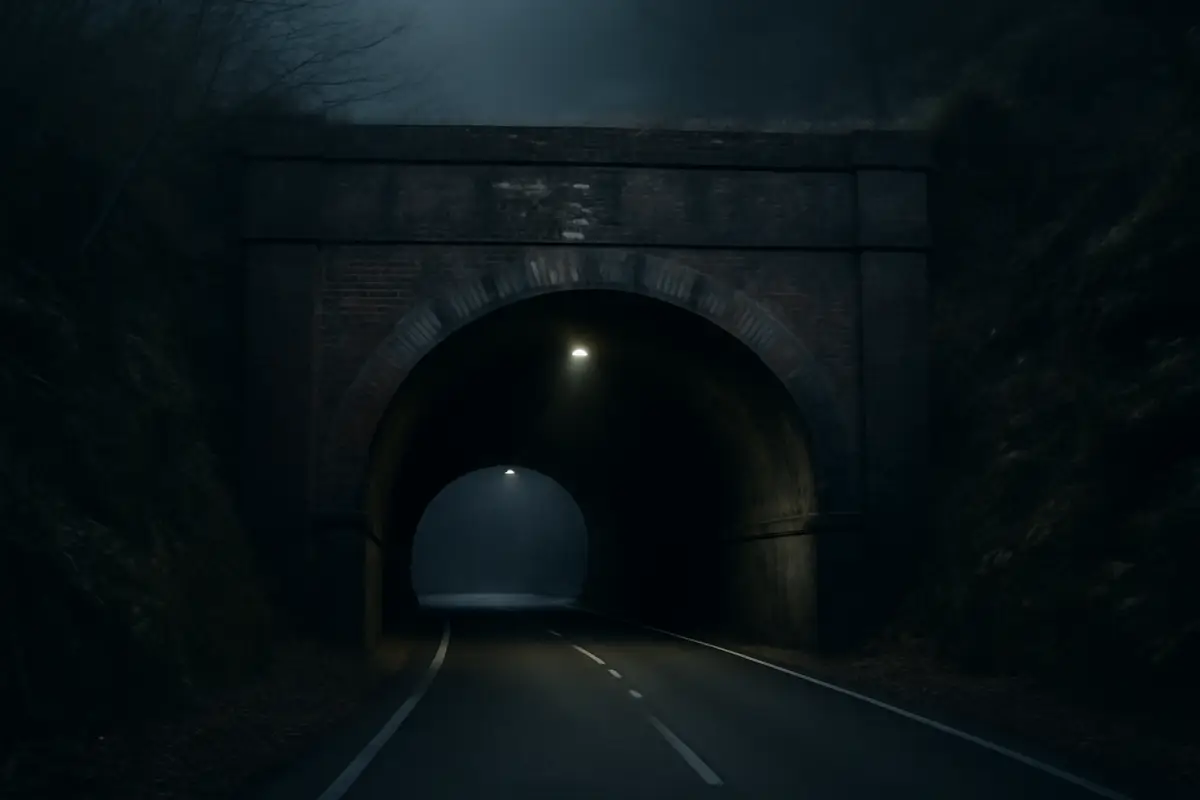
Yamanaka Tunnel is the largest of thirteen brick railway tunnels built between Tsuruga and Fukui as part of the original Hokuriku Main Line, crossing the historically difficult Kinome Pass. This is one of the rare “haunted tunnel” sites where the real history is thoroughly documented.
- Verified history
- What locals say
- Assessment
- A Rare Case: Fully Documented Engineering, Undocumented Ghosts
- Part of a Wider Pattern: Haunted Tunnels Across Japan
- Frequently Asked Questions
- Is Yamanaka Tunnel a registered historic site?
- Did workers really die building Yamanaka Tunnel?
- Can you still visit Yamanaka Tunnel today?
- Why was Yamanaka Tunnel considered so difficult to build?
- Why are so many tunnels in Japan considered haunted?
- Is Japan considered a haunted country?
- What makes an abandoned tunnel a likely setting for a ghost story in Japan?
- Related Stories
Verified history
Construction took place 1893–1896; this section opened as part of the original Hokuriku line. The tunnel is a brick-lined rail tunnel roughly 1,170 meters long, considered one of the two most difficult tunnels to build on the entire original line. It remained in railway use until 1962, when it was replaced by the new Hokuriku Tunnel, after which the rail bed became part of National Route 476. In February 2016, it was registered as a national Tangible Cultural Property.
What locals say
Local legend describes a woman in a red dress near the tunnel's midpoint and an elderly figure near one exit, sometimes connected to villagers said to have died of smoke inhalation during the steam-locomotive era — a genuine, well-documented hazard on Japan's early railways generally. We could not confirm a specific, named smoke-related death at this tunnel.
Assessment
Unusually, the tunnel's construction, engineering significance, and heritage status are all matters of public record; the ghost stories layered on top remain unverified legend.
Can you visit: Yes — carries a public prefectural road and is a recognized heritage/tourism spot; unlit inside.
A Rare Case: Fully Documented Engineering, Undocumented Ghosts
Yamanaka Tunnel stands out on this site precisely because its non-supernatural history is unusually complete — construction dates, engineering difficulty, heritage registration, all a matter of public record. That completeness makes the gap more visible than usual: the ghost claims attached to it (the woman in red, the elderly figure) have no equivalent documentation, despite riding on the back of a site whose real history is otherwise exceptionally well recorded.
Part of a Wider Pattern: Haunted Tunnels Across Japan
Yamanaka Tunnel (山中トンネル), Fukui Prefecture is one of dozens of similar sites documented across this site, and it fits a recognizable pattern rather than standing alone. Roughly three-quarters of Japan’s land area is mountainous, which has required over a century of tunnel construction, and older bores are typically sealed or abandoned rather than demolished once a wider, better-lit replacement opens nearby. Those abandoned alignments — not the tunnels still in daily use — are where the folklore tends to concentrate: narrow, unlit, and left to decay in a way that reads as ominous even when the underlying cause is a routine highway upgrade. Japan’s long kaidan (ghost story) storytelling tradition, which attaches spirits to liminal spaces such as tunnels, bridges, and mountain passes, gives these sites a ready-made narrative frame.
Frequently Asked Questions
Is Yamanaka Tunnel a registered historic site?
Yes — it was registered as a national Tangible Cultural Property in February 2016, one of the more thoroughly documented tunnels on this site.
Did workers really die building Yamanaka Tunnel?
Smoke inhalation was a genuine, well-documented hazard on Japan’s early steam-railway lines generally, but we could not confirm a specific, named death tied to this tunnel.
Can you still visit Yamanaka Tunnel today?
Yes — it now carries a public prefectural road and is a recognized heritage and tourism site, though unlit inside.
Why was Yamanaka Tunnel considered so difficult to build?
It was one of the two most difficult tunnels to construct on the entire original Hokuriku Main Line, crossing the historically challenging Kinome Pass during 1893–1896 construction — a genuine engineering feat documented independently of any ghost claim.
Why are so many tunnels in Japan considered haunted?
Japan’s mountainous terrain (roughly three-quarters of the country) has required over a century of tunnel construction, and old bores are typically abandoned rather than removed once a newer route opens nearby. Combined with a long kaidan (ghost story) tradition of attaching spirits to liminal spaces, these abandoned tunnels became natural settings for local ghost stories.
Is Japan considered a haunted country?
Japan has one of the world’s richest documented traditions of ghost stories and haunted-location folklore, built up over centuries through kaidan storytelling, yokai folklore, and site-specific legends attached to tunnels, forests, and other liminal places. That reflects a deep cultural and narrative tradition — not a verifiable claim about supernatural activity.
What makes an abandoned tunnel a likely setting for a ghost story in Japan?
Age, disuse, and physical decay do most of the work: a dark, damp, overgrown structure that once carried traffic and now carries none reads as unsettling on its own, independent of any specific incident. As with Yamanaka Tunnel (山中トンネル), Fukui Prefecture, the underlying history is often more mundane — a routine bypass or road realignment — than the legend suggests.
As an Amazon Associate, this site earns from qualifying purchases.
Comments