
<p>This article contains affiliate links. If you buy through them, we may earn a commission at no extra cost to you.</p>
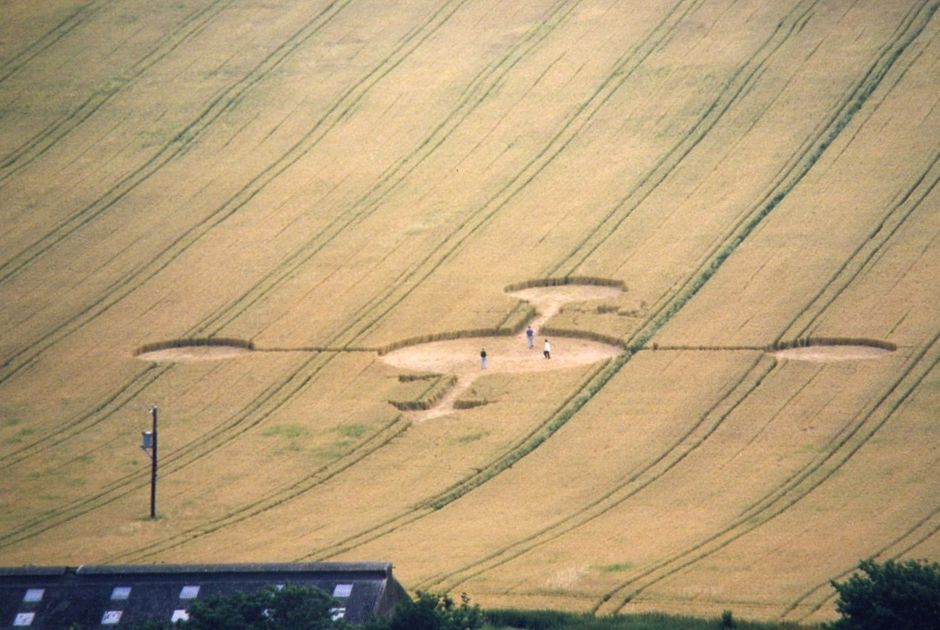
In 1991, two retired Englishmen named Doug Bower and Dave Chorley walked into a British newspaper's offices and admitted something that unraveled over a decade of speculation almost overnight: they had been flattening intricate circular patterns into farmers' fields across southern England since the late 1970s, using nothing more sophisticated than a plank of wood, a length of rope, and a wire-rigged baseball cap to help them walk in a straight line in the dark.
Verified History: The Confession and the Method
Bower and Chorley said their inspiration traced back to a 1966 newspaper report describing a supposed UFO landing that had left a flattened patch of reeds — an idea that stuck with them for over a decade before they decided to recreate the effect themselves. Their method, which they demonstrated for journalists after coming forward, involved one person holding a rope taut from a central point while the other dragged a plank across the crop in a widening spiral, flattening stalks in clean, deliberate patterns that could be completed within a few hours under cover of darkness.
To prove their claim, the pair created a new circle in front of reporters and then invited a well-known crop circle researcher, Pat Delgado, to examine it without telling him it was staged. Delgado, who had built a public reputation studying the phenomenon and arguing for its unexplained nature, examined the formation and declared it authentic — and was reportedly startled and disappointed to learn afterward that it was one of the men's own hoaxes. That single demonstration did more to shift public opinion than years of prior skepticism had managed.
The Legend: Thousands of Circles, Two Confessed Hoaxers
Here's where the documented facts get more complicated than the tidy “hoax solved” headline suggests. Bower and Chorley claimed responsibility for roughly 200 circles made across more than a decade. But by their own admitted timeline, thousands of additional crop circles were reported elsewhere in the same years, including in countries they had no connection to — a gap that has kept some researchers and enthusiasts arguing that the two men's confession, real as it was, doesn't fully account for the broader phenomenon.
What followed their confession was, if anything, an explosion of new copycat circle-makers, some of them making public sport of the hobby, along with dedicated online communities and “croppie” researchers who continue to study formations for patterns, plant-bending techniques, and other physical characteristics they argue distinguish more sophisticated modern circles from simple rope-and-board work. Whether those distinguishing features indicate anything beyond skilled, patient human construction remains, itself, unresolved and debated.
What's Actually Verifiable
Bower and Chorley's 1991 confession is a matter of public record, documented on video and in contemporary newspaper coverage, including their live demonstration for journalists and Delgado's on-camera assessment. What is not resolved: exact attribution for the thousands of other reported circles from the same era and since, since no comparable full confession exists for the majority of them, and hoaxing groups since the 1990s have rarely come forward the way Bower and Chorley did. Mainstream science treats crop circles broadly as human-made art, largely on the strength of demonstrated construction methods and repeated hoaxer confessions over the decades, while a smaller community of researchers continues to argue that some formations show construction characteristics that are harder to explain with simple tools — a claim that remains actively disputed rather than independently settled either way.
FAQ
Did Doug Bower and Dave Chorley really confess to making crop circles?
Yes, in 1991, and they demonstrated their rope-and-plank method for journalists at the time.
Does their confession explain all crop circles?
No — they claimed around 200 circles, while thousands more were reported in the same period from sources never traced back to them.
What inspired them to start making circles?
A 1966 newspaper report describing a supposed UFO-related flattened reed patch, an idea they said stuck with them for years before they acted on it.
Are crop circles still being made today?
Yes, new formations continue to appear, generally attributed to copycat human circle-makers rather than anything unexplained.
Did any experts examine their hoax and believe it was real?
Yes — researcher Pat Delgado examined one of their staged circles without knowing it was fake and initially declared it authentic.
Is there scientific consensus on crop circles?
The mainstream scientific position treats them as human-made, though a small community of researchers continues to argue that some formations show unexplained characteristics.
Gear & Further Reading
For the fullest documented account of how the crop circle hoaxing culture actually operated, Jim Schnabel's Round in Circles: Poltergeists, Pranksters, and the Secret History of the Cropwatchers is widely cited — Schnabel spent time embedded with British circle-makers and researchers alike while writing it.
Related reading: our International Ghost Stories & Haunted Places guide covers more phenomena with a documented, dated resolution like this one.
As an Amazon Associate, this site earns from qualifying purchases.
Comments